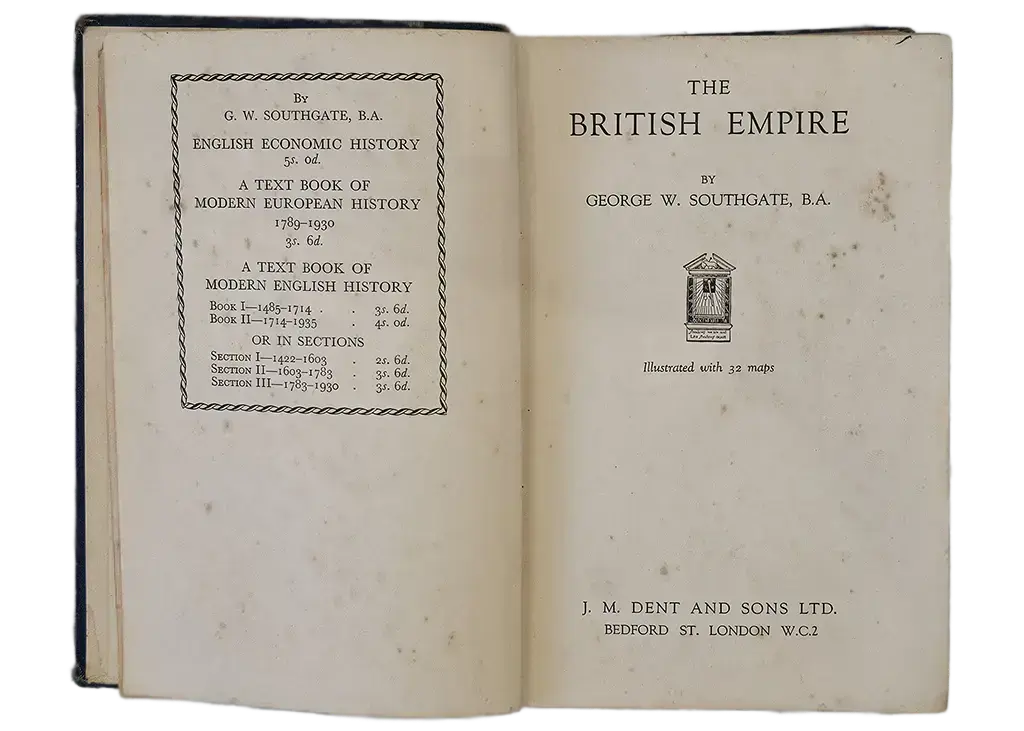
The British Empire by George W Southgate BA, Published by JM Dent And Sons Ltd, Bedford St. London WC2 in 1936.
Sorting through my parents papers, post probate, my sister and I came across a school textbook that my father had kept: The British Empire by George W Southgate BA published in 1936.
On the inside cover of this book it says: James H Burton form IV Harrison College 1939, and it has his address as Woodford, Strathclyde, Barbados.
Inside cover of: The British Empire by George W Southgate BA, Published by JM Dent And Sons Ltd, Bedford St. London WC2 in 1936. The 6/6 in pencil in the top right corner was probably the price of 6 shillings and 6 pence?
This book had been used the previous year in 1938 by someone in form IVB (name rubbed out). The book’s previous owner might have been George R Gill whose name/signature is on the back cover, with some notes in pencil.
Reproduced below are three verbatim extracts from: The British Empire by George W Southgate BA published in 1936:
These extracts portray how in 1938/1939 the British Empire and the Colonies were seen and how this history was taught at Harrison College – using a text book that was relatively new and up to date, which had been first published a few years previously in 1936.
PREFACE
THE history of the British Empire, political, constitutional, and economic, does not receive in the schools of Great Britain the attention it deserves. This does not mean that the importance of the subject is overlooked, but that, in view of the limited amount of time available for the study of history, something has to be neglected. It is hoped that this work, which aims at providing an adequate general account of Imperial development, will be of use in those schools in which the subject already receives attention and that it will encourage its study in many others.
The author has endeavoured to place emphasis on the more modern aspects of Imperial development, so that the reader may be made acquainted with the actual problems which confront the statesmen and people of the British Empire at the present day and may take an intelligent interest in the future course of events. For the convenience of students who wish to make use of the book for examination purposes summaries of the chapters are appended. Sketch-maps are given where required for the illustration of the text.
A word of explanation of the arrangement of the chapters may be given. It was felt that a general chronological narrative, ranging over the whole field, would not leave a clear impression on the mind of the reader. Nor, for various reasons, was a purely geographical division of the subject satisfactory. An attempt has been made to secure the advantages of both methods of presentation. The first few chapters are devoted to the early settlements and the Old Colonial System as far as the loss of the American colonies. The Dominions are then dealt with in turn. A consideration of Indian history follows, and, after some account of the tropical possessions, the work concludes with some remarks on the Empire as a whole. It should be pointed out, however, that the chapters are sufficiently complete in themselves to make it possible for them to be read in almost any order. For example the study of the history of the Indian Empire need not be postponed until after that of the Dominions has been completed, nor need the Dominions be taken in the order given. Wherever necessary, references to other parts of the book are given in footnotes.
The thanks of the author are due to his friend and former pupil, Mr. L. A. Pye, B.A., for his kindness in permitting the use of a mass of notes and other material bearing upon the subject.
G. W. S. February 1936.
Chapters heading for: The British Empire by George W Southgate BA, Published by JM Dent And Sons Ltd, Bedford St. London WC2 in 1936.
Pages V – VII: The British Empire by George W Southgate BA, Published by JM Dent And Sons Ltd, Bedford St. London WC2 in 1936.
CHAPTER XVIII: THE BRITISH WEST INDIES
THE West Indies consist of a large number of islands lying, for the most part, in two parallel chains. The main, or inner, line, known as the Antilles, THE West Indies consist of a large number of islands lying, for the most part, in two parallel chains. The main, or inner, line, known as the Antilles, encloses the Caribbean Sea. The Greater Antilles include Cuba, Jamaica, Haiti, and Porto Rico; of these only Jamaica is British. The Lesser Antilles, extending from the Virgin Islands to Trinidad, are subdivided into the Windward and the Leeward Islands1. The Leeward Islands2 extend from the Virgin Islands to Martinique and the Windward Islands3 from St. Lucia to Trinidad. The outer line of islands, the Bahamas, is of coral formation. There is a further chain of small islands parallel to the coast of Venezuela, and an isolated group, the Bermudas, also of coral formation, far out in the North Atlantic.
The reader may be assisted by the following tabular arrangement:
The expression “West Indies” is geographical rather than political. Some of the islands are French or Dutch or American, and others are British, while a few are independent republics. The British West Indies are often understood to include certain mainland colonies, in addition to the islands.
Nine different administrative units (colonies or groups of colonies)4 can be distinguished Barbados, the Leeward Islands, the Windward Islands, Jamaica (with its dependencies the Turks and Caicos Islands and the Caymans), the Bahamas, the Bermudas, Trinidad with Tobago, British Guiana, and British Honduras. As will be shown in the course of this chapter, attempts have in the past been made to form a single West Indian Government of a federal character. These efforts have not been successful, though within the last few years a West Indian Conference has come into existence.
From the time of their discovery the West Indies formed a convenient line of approach to the New World, since voyagers to them from Europe could take advantage of the north-east trade wind and could evade the dangers to be apprehended in the North Atlantic. Most of the West Indies were discovered by Spaniards, who, however, in the sixteenth century were more intent upon securing the mineral wealth of the American mainland than upon colonising the islands. They took possession of the Greater Antilles and of Trinidad, but they neglected the smaller islands, and early in the seventeenth century adventurers from Great Britain and other European countries appeared in the Lesser Antilles. English explorers took possession of the island of Barbados5 in 1625, and effective settlement was begun soon after. From this time, however, Barbados became important. The colonists were substantial men who cultivated large sugar estates by slave labour white/and black. The white slaves were English, Scots, or Irish6, who had been kidnapped, or who had been convicted of serious crime and sent overseas, or who had been captured in war. Such men occasionally secured their liberty after a period of service, and might become landowners. Negro slaves were imported in large numbers, and in course of time they became the main element in the population. Sugar was the chief product of the island, but tobacco, indigo, and cotton were introduced and cultivated.
A representative Assembly was established in Barbados in 1639. The planters were loyal to the Stuarts, and after the execution of Charles I they proclaimed his son as king. They were compelled to submit to the Commonwealth in 1652, but they retained their Assembly and were subjected to very little interference from the English Government. Soon after the submission of Barbados Prince Rupert appeared off the island with a small fleet. He was joined by his brother Maurice, and a few ships were destroyed by them at Nevis and St. Kitts. Maurice was drowned in a storm, and Rupert returned to Europe.
The white population of Barbados was very considerable by the middle of the seventeenth century. For a time under Charles II it was the headquarters of the Government of the Windward Islands, but its prosperity was adversely affected by the competition of other islands in the production of sugar. Barbados was attacked by the French during the eighteenth century wars, but it never actually changed hands.
The island of St. Christopher, or St. Kitts, was settled by Englishmen in 16237, and in 1627 a charter was granted by /Charles I to James Hay, Earl of Carlisle, by which he was given authority over Barbados, St. Kitts, and the Caribbees (the present Windward and Leeward Islands) generally. In 1625 a French settlement was made on the other side of St. Kitts, and it was agreed that the island should be divided, the English settlers taking the middle and the French holding either end. Trouble with the Caribs, a warlike native race, followed, and English and French cooperated against them, but in 1629 the Spanish attacked the island and destroyed the settlements. These were restored, but some years later the French attacked their neighbours and took possession of the whole of the island. By the Treaty of Breda, 1667, the right of the English to a part of the island was recognised. They were expelled in 1689, but they captured the whole island in 1690, and the French part was not handed back until the/Treaty of Ryswick, 1697. The English again became masters of the whole island in 1702 and retained it by the Treaty of Utrecht, 1713. During the War of American Independence, in 1782, the French attacked St. Kitts in great force and captured it, but it was recovered by the British by the Treaty of Versailles, 1783. Two attacks by the French, in 1805 and 1806, were unsuccessful.
Settlement in other islands was undertaken from St. Kitts. Nevis was occupied in 1628. In the eighteenth century it became the “slave market” of the Leeward Islands and attained great prosperity. Antigua was first settled in 1632. The colonists experienced trouble from time to time with the Caribs. The island was captured by the French in 1666, but it was restored to the English by the Treaty of Breda, 1667. Montserrat, occupied in 1632, shared the experiences of St. Kitts and Antigua. It was lost to the French in 1664 and restored in 1667; lost again in 1782 and finally recovered in 1783.
The French from St. Kitts attempted to colonise Dominica in the seventeenth century8, but the Caribs held their own for a long time, and in the Treaty of Aachen, 1748, Dominica was declared to be neutral. In spite of this, a French settlement was formed, and was captured by the British in 1759. The island was retained by Great Britain by the Treaty of Paris, 1763. It was lost to the French in 1778 and recovered in 1783. French efforts to reduce it in the course of the Revolutionary Wars met with no success.
The Virgin Islands were used by the buccaneers, who established some sort of settlement upon them in 1666. They were at length annexed to the Leeward Islands. From its first settlement in 1638 St. Lucia changed hands between French and British frequently until 1748, when by the Treaty of Aachen it was declared to be neutral. Falling into British hands in 1762, it was restored to the French by the Treaty of Paris, 1763. It was again captured by the British in 1778 and again restored, by the Treaty of Versailles, in 1783. Taken in 1797, it was restored for the third time in 1802; it was taken yet again in 1803, and this time it was retained.
Attempts to settle on St. Vincent in the seventeenth century failed on account of the hostility of the Caribs. The island was one of those declared in the Treaty of Aachen to be neutral. It was captured by the British in 1762 and was retained by the Treaty of Paris in the following year. Difficulties with the Caribs were overcome by the reservation of a part of the island for their use. Taken by the French in 1779, it was restored to Great Britain in 1783. The Caribs revolted in 1795 and were suppressed in the following year.
An unsuccessful English attempt was made to establish a colony in Grenada as early as 1609, and the real settlement of the island was undertaken by the French from Martinique in 1650. It was captured by the British in 1762 and was one of the islands retained by Great Britain by the Treaty of Paris, 1763. It was retaken by the French in 1779, but Great Britain recovered it by the treaty of 1783. The population was mainly French, and during the Revolutionary War a serious revolt occurred. This was suppressed, and the rebels were punished.
An important addition was made to the list of British possessions in the West Indies in 1655, when Jamaica was captured. It had been occupied by Spaniards in the sixteenth century, but had not received the attention accorded to larger islands such as Cuba and Haiti. An expedition under Penn and Venables had been sent by Cromwell to attack Haiti (Hispaniola), the seat of Spanish power in the West Indies. It failed in its main purpose, and turned to Jamaica, which was not strongly held and was easily taken. The Cayman Islands were captured by the English soon after the conquest of Jamaica, and they were ruled from that island. The English possession of Jamaica was recognised by Spain in the Treaty of Madrid, 1670. In the late seventeenth century Jamaica became the resort of the buccaneers, one of whom, Sir Henry Morgan, was its Governor from 1674 to 1682. The home Government took no serious steps to suppress these pirates, whose activities were directed mainly against the Spanish, and they flourished until well into the eighteenth century. In course of time Jamaica was peopled by settlers of various types from all parts of the British Isles and from the New England colonies. The prosperity of the colony, like that of many of the other West Indian islands, depended on the production of sugar by slave labour. An elected Assembly was set up by Charles II as early as 1662, which, in spite of friction with the home Government, succeeded in retaining its privileges.
In the eighteenth century the Government of Jamaica experienced a good deal of difficulty with the Maroons, descendants of runaway slaves, who inhabited the hilly interior of the island. The Maroons were numerous and they occasionally broke out in revolt. They were granted certain lands as reserves, and in 1842 they received full civil rights. As late as 1865 they revolted again. Governor Eyre suppressed the revolt with severity according to his critics, with unnecessary severity.
Turks Islands and Caicos Islands were occasionally visited by saltrakers from the Bahamas at the beginning of the eighteenth century. In 1799 they were attached to the Bahamas, to which, geographically, they belong, but in 1848 they were transferred to the jurisdiction of the Governor of Jamaica.
No English settlement appears to have been made on the Bahamas until nearly the middle of the seventeenth century9. In 1670 they were included within the sphere of the Carolina Company. For many years little progress was made, though an elected Assembly was set up. One of the islands, New Providence, was plundered by Spaniards in 1684. The inhabitants of the Bahamas were addicted to piracy rather than to industry; the notorious pirate Edward Teach (Blackbeard) made one of the islands the centre of his operations. Nor until 1718, in the reign of George I, was any serious attempt made to suppress piracy in this region. During and after the War of American Independence the Bahamas received an accession of population by reason of the immigration of a number of American Loyalists. New Providence was captured by Spaniards in 1781 but was restored to Great Britain by the Treaty of Versailles, 1783. The American immigrants into the Bahamas introduced the cultivation of cotton, which was for many years the staple product of the islands. More recently the production of cotton has been discontinued in favour of that of sisal10.
The Bermudas were settled early in the seventeenth century. In 1609 Sir George Somers was wrecked on one of the islands of the Bermudas11 while voyaging to Virginia. Attention was drawn to the group, and in 1612 the Bermudas passed under the control of the Virginia Company. Soon afterwards a separate company was formed, and settlers were sent to the islands. The Virginian system of estates worked by slave labour was set up; tobacco was the chief product. A Representative Assembly was instituted in 1620. Like Barbados and other colonies of this type, the Bermudas were Royalist in sentiment, and would not recognise the Commonwealth until compelled to do so. The prosperity of the Bermudas continued after the Restoration, and in 1684 the settlers secured freedom from the authority of the Company, which was dissolved.
Trinidad, which was discovered by Columbus on his third transatlantic voyage, in 1498, was definitely occupied by Spaniards after 1532, and the towns of San José and Port of Spain were founded. San José was captured and sacked by Sir Walter Raleigh in 1595. For more than two centuries Trinidad had few inhabitants of European extraction, but after 1780 there was an influx of Frenchmen, encouraged by the Spanish authorities. In 1796 a British ship of war, the Alarm, visited Port of Spain in connection with operations which were being undertaken against French privateers. (At this time Great Britain was at war with France but not yet with Spain.) Fighting broke out in the streets of the port between British seamen from the Alarm and some of the privateersmen. The incident was treated as a violation of neutrality by Spain, and was one of the matters which led shortly afterwards to a declaration of war against Great Britain by Spain. Sir Ralph Abercromby set out from Martinique to capture Trinidad. The Spanish surrendered it without offering any resistance. By the Treaty of Amiens, 1802, it was retained by Great Britain.
The first attempt to form a settlement in Tobago was made in 1639. Its history for more than a century is a record of kaleidoscopic changes, in which French, Dutch, Courlanders, Jamaicans, Caribs, and London merchants all had parts. By the Treaty of Aachen, 1748, the island was declared to be neutral. It was captured by the British in 1762 and it remained in British possession by the treaty of 1763. It was taken by the French in 1781 and retained by them under the treaty of 1783; by the British in 1793, and returned to the French by the Treaty of Amiens, 1802; again by the British in 1803, and retained by them under the Treaty of Paris, 1814.
Dutch settlements were formed at various points on the coast of Guiana before the close of the sixteenth century, and by the Treaty of Münster, 1648, the rights of the Dutch in this region were recognised. During the eighteenth century the Dutch were outnumbered by settlers from other countries. Englishmen from Barbados introduced the cultivation of sugar, coffee, and cotton, and in 1781 the Dutch settlements were captured by the British, who, however, in the following year lost them to the French. The Treaty of Versailles, 1783, restored them to the Dutch. They were seized again by a British expedition from Barbados in 1796, and again restored to the Dutch in 1802. The Guiana settlements were captured by the British for the third time in 1803, and when peace was made in 1814 the counties of Essequibo, Demerara, and Berbice were retained. In 1831 they were united to form the colony of British Guiana.
Settlements in Honduras and on the islands off its coast were attempted by Spain and England before the middle of the seventeenth century, the earliest English settlers being ex-buccaneers led by a man named Willis12. They were attracted by the possibility of obtaining logwood and mahogany. The Indians were not unfriendly, and in 1739 a native chief resigned his territory to the British. (The Spanish at this time contested the right of the English to cut logwood in the Bay of Campeachy. This was one of the petty points which brought about the Anglo Spanish War known as the War of Jenkins’s Ear.) By the Treaty of Paris, 1763, Great Britain agreed to dismantle certain fortifications, but the British settlers remained, and resisted the attacks of the Spanish. The most serious attempt by the Spanish to dislodge the British occurred in 1798. At the Battle of St. George’s Cay the Spanish were driven off with heavy losses. They made no further effort to molest the “Baymen,” as the British settlers were called.
It has already been stated that the prosperity of the West Indies was based on the production of sugar, and it may be pointed out that the frequent attacks upon West Indian islands during the eighteenth century wars were inspired by the desire of each of the powers of western Europe to make sure of its own supply of this commodity and to deprive its enemies of theirs. It was for this reason that the West Indies were in the eighteenth century regarded as the most valuable of the British possessions overseas. The retention, by the Treaty of Paris, 1763, of the Canadian settlements on the St. Lawrence and the return of some of the sugar islands to France were features of the treaty which were severely criticised.
The cultivation of the sugarcane was carried on by means of the labour of negro slaves, and the supply of negroes to the West Indies and South America was itself an important branch of British trade. The Portuguese developed the negro slave traffic in the sixteenth century, and from the beginning of the seventeenth century they had to face Dutch competition. The right to import slaves into Spanish colonies was a monopoly known as the Asiento, and it was at different times granted by the Spanish Government to Dutch, French, and British contractors. It was held by the South Sea Company from 1713 to 1739, and again from 1748 to 1750. The slave trade to the British West Indies was in the hands of the Royal African Company in the later Stuart period, but in 1689 the trade was thrown open to all English merchants. In the eighteenth century it was carried on by merchants of Liverpool and Bristol, and London had some share in it; it is said, however, that six-sevenths of the trade was controlled by Liverpool. In the latter part of the eighteenth century the traffic reached such dimensions that 100,000 slaves crossed the Atlantic annually. The normal voyage was triangular. Slave ships went from England to West Africa, where they obtained their complement of negroes. These were taken across to the West Indies and sold, and, before their return home, the ships were laden with colonial produce for English markets. The horrors of the “middle passage” (from Africa to America) are well known and need no description. That a substantial percentage of the slaves should die on the voyage was regarded as a normal occurrence. If the ship encountered heavy weather the shipmaster did not hesitate to cast a part of his human cargo into the ocean to perish, in order to lighten the ship. Negroes who died on board ship represented a loss; those who were cast away to preserve the safety of the vessel were paid for by the insurance company
From a purely economic standpoint the introduction into the West Indies of negro slave labour was attended by both advantages and disadvantages. It was contended, and with justice, that apart from it the industrial development of the West Indies would have been impossible. No other supply of labour was available; the Caribs were warlike and untameable, and other American native races were not sufficiently hardy to undertake regular labour enforced by severe discipline. But slave labour is rarely skilful. The negro stands low in the scale of human intelligence. There was little opportunity or inducement for white men to migrate to the islands, and the white population remained small-an aristocracy lording it over a mass of coloured inferiors, from whom there was the constant peril of revolt.
In 1776 a motion for the abolition of the slave trade was brought forward in the House of Commons. It was not carried, and in 1787 a Society for the Abolition of the Slave Trade was formed by William Wilberforce, Thomas Clarkson, and Zachary Macaulay. Much opposition was offered to the propaganda work of the society by those whose interests would be affected. It was asserted that Liverpool and Bristol would sink to the level of third rate ports if the slave trade should cease, and that the prosperity of the West Indian colonies would be ended. The planters of the West Indies subscribed large sums of money in order that opposition to the work of the society might be maintained. But humanitarian views at length prevailed, and in 1807 Great Britain passed an Act for the Abolition of the Slave Trade. At the Congress of Vienna, 1815, the British example was followed by France, Spain, Portugal, and Holland.
After 1807 the planters were unable to obtain fresh supplies of slaves from overseas, and they had to rely upon the natural increase of the negro population of the islands. It is probable that in view of their augmented value the slaves received better treatment than in the eighteenth century.
Slavery in British colonies was ended by an act passed in 1833. Compensation was paid to slave owners for the loss of their property, but, as stated elsewhere in this book13, both the amount and the method of payment of the money were open to criticism. The prosperity of the islands was seriously affected, because sugar continued to be produced by slave labour in the Spanish colonies of Cuba and Porto Rico, and in Brazil. Many planters were faced with ruin, and the market value of sugar estates fell to a mere fraction of its former level. The folly of relying upon a single product for the prosperity of the colonies was evident, and in some islands ruin was averted by the introduction of other and more profitable crops. Grenada throve upon the production of cacao and St. Vincent by the cultivation of sea island cotton, while, towards the end of the nineteenth century, the cultivation of cacao and spices was developed in Dominica. Jamaica also developed the production of bananas. But in many of the islands the depression continued till the early years of the twentieth century.
Efforts were made in course of time to obtain a supply of cheap labour from Asia. Chinese coolies were brought to the West Indies in large numbers after 1853. This movement ceased after 1866, but in British Guiana the Chinese still form an important and industrious element in the population. As early as 1837 Indians were brought to British Guiana as indentured labourers. This was too soon after the abolition of slavery, and an outcry arose, it being contended that slavery was being reintroduced in disguise. The contracts were cancelled, but in 1844 the importation of Indian indentured labourers into Jamaica, Trinidad, and British Guiana was sanctioned. From time to time the system has been subject to criticism, but an investigation by the British Government in 1910 disclosed no serious grounds of complaint.
The labour problem was not the only difficulty which the sugar industry of the West Indies had to face in the nineteenth century. At first, indeed, after the abolition of slavery the planters received a partial protection by the differential scale of duties on sugar imported into the United Kingdom. The duty levied on British colonial sugar was fourteen shillings per hundredweight, while that on sugar from foreign sources was exceedingly high. Lord John Russell in 1846 lowered the duty on foreign sugar to twenty one shillings per hundredweight, and, after five years, to fourteen shillings. This discontinuance of the preference to the colonies was in accordance with Free Trade principles, but it intensified the depression in the West Indies.
The greatest hindrance to the recovery by the West Indies of their predominance in the production of sugar lay in the prevalence of the bounty system on the continent of Europe. The production of sugar from beetroot had been begun in the time of Napoleon, when West Indian sugar could not find its way to continental ports on account of the British blockade. In subsequent years the French Government stimulated the production of beet sugar by offering a bounty on its export, and other countries followed suit. This bounty fed sugar found its way in vast quantities to the United Kingdom, where it was sold at much below the real cost of production14. Efforts were made as early as 1877 to secure the discontinuance of the bounty system, but, in the absence of complete agreement among those Governments which offered bounties, no action was possible, unless, indeed, Great Britain would undertake to prohibit or penalise the importation of bounty fed sugar. While Free Trade principles prevailed in their completeness in Great Britain no such course was possible, and it was not until the Brussels Convention of 1902 that this country agreed to prohibit the import of sugar which had received bounty assistance either in production or in export. The bounty system thus received a fatal blow, and in several countries it was discontinued in 1903. Russia was not represented at the Brussels Convention, and for a time her policy seemed uncertain, but in 1907 she brought the bounty system to an end.
Great Britain thus agreed to forgo the advantage of cheap sugar in order to assist her distressed West Indian dependencies. The West Indies received great benefit from this change of policy. The production of sugar revived, and within a few years there was a greater degree of prosperity in the islands than had been felt at any time in the second half of the nineteenth century.
In 1897 the Dominion of Canada granted a preference of 25 per cent on raw sugar imported from the West Indies. The planters at this time, however, had a better and more convenient market for their product in the United States, since the republic imposed countervailing duties on bounty fed sugar, and no great advantage was taken of the Canadian preference. This was increased in 1900 to 33 per cent, and in 1907 to 37 per cent. Meanwhile, the abolition of the bounty system in Europe involved the discontinuance of the countervailing duties in the United States, which, moreover, was increasing its own production of sugar to the point of self sufficiency. Greater attention, therefore, was paid by the planters to the possibilities of the Canadian market, and before long it was being asserted that they were acting in combination to raise prices to an artificial level. The charge was repudiated in the West Indies, and a Royal Commission was appointed by the British Government to investigate the matter. After full inquiry, the Commission came to the conclusion that, in view of the distance of the islands from one another, the difficulty of communication, and the diversity of conditions, anything like a general combination of planters not only did not, but could not, exist. A regular steamer service between the West Indies and Canada has assisted in the promotion of trade, and a commercial agreement which was entered into in 1912 was extended in 1920 and again in 1925.
A Royal Commission was sent to the West Indies by the British Government in 1897 in order to investigate and report on economic conditions. As a result of its recommendations an Imperial Department of Agriculture was established at Barbados, and some years later this developed into the West Indian Agricultural College in Trinidad. This, in its turn, was enlarged and its functions extended in 1923, and it was renamed the Imperial College of Tropical Agriculture.
It has been mentioned above that, by the peace of 1814, the three counties of Essequibo, Demerara, and Berbice were retained by Great Britain and that, subsequently, they were united to form the colony of British Guiana. The boundaries between the colony and its neighbours Venezuela and Brazil remained uncertain, and in 1840 the British Government sent Sir Robert Schomburgk to mark them out. A line, subsequently known as the “Schomburgk line,” was fixed, which included within British Guiana the whole of the basin of the Demerara River, it being contended that this was the boundary of the former Dutch colony. But this was in conflict with the Venezuelan claim to extend as far as the Essequibo River. No action was taken at the time by either state, and in 1886 Great Britain announced her intention of exercising jurisdiction as far as the Schomburgk line, slightly modified. The Venezuelans did not agree with this, and in 1895 the situation became acute when Venezuelan police arrested two British officials within the disputed territory. The British Government protested, but the President of the United States, Grover Cleveland, intervened, and revived the Monroe doctrine of 1823, which declared that European powers might not look upon any part of the American continent as a field for colonial expansion. He demanded that Great Britain should submit her claim against Venezuela to the arbitration of the Government of the United States. For a time there was danger of war between Great Britain and the United States, but Lord Salisbury, Prime Minister and Foreign Secretary of the United Kingdom, acted in the crisis with great wisdom and firmness. He contended that Great Britain was an American as well as a European power and that British territory in the New World covered a greater area than that of the United States. He offered to submit the British case to the American Government in order to demonstrate its justice, but declined to be bound by any American decision. A mixed arbitration tribunal was agreed upon, and its decision in 1899 was almost entirely in favour of the British claim. The Schomburgk line, slightly modified near the coast, was declared to be the boundary between Venezuela and British Guiana.
In the boundary dispute between British Guiana and Brazil the King of Italy was invited to act as arbitrator, and in 1904 he gave a decision in favour of the British claim.
Constitutional development in the West Indian colonies followed, up to a point, the normal course to be observed elsewhere, and representative institutions existed in many of the islands and groups. The decline in West Indian prosperity which characterised the second half of the nineteenth century was accompanied by constitutional retrogression instead of progress. In some of the colonies representative institutions were surrendered, and Crown Colony rule was re-established.
Barbados, alone among the West Indian colonies, has retained representative institutions without a break. Its Legislature consists of a Legislative Council, nominated by the Governor, and a House of Assembly of twenty four members, elected annually. A peculiarity of the constitution of Barbados lies in the fact that no Government official enjoys a seat in either Chamber. There is an Executive Council, the members of which, with one exception, are appointed by the Governor; the exception is the Treasurer, who is elected by the House of Assembly. When considering financial matters the Executive Council is reinforced by the addition of one member from the Legislative Council and four from the House of Assembly, and is then styled the Executive Committee.
The Leeward Islands were separated from Barbados and the Windward Islands in 1671. They were placed under the authority of a Captain-General, who at first resided at Nevis and later at Antigua. There was a Lieutenant-Governor for each island. During the eighteenth century a federal Legislature existed, but owing to difficulties of communication it met rarely, and not at all after 1798. In 1816 the Leeward Islands were divided into two groups, which, however, were reunited in 1832. The federal organisation was revived in 1871, and the Leeward Islands now present the only example of a federation in the West Indies. There are five “presidencies” in the group – Antigua (which contains the head-quarters of the Federal Government) with Barbuda, St. Kitts with Nevis and Anguilla, Dominica, Montserrat, and the Virgin Islands. Formerly they had nominated Legislative Councils and elected Assemblies, but representative institutions have been abandoned, and each of them, except the Virgin Islands, now has a nominated Legislative Council only15, some of the members of which are official and others non-official. Since 1871 there has been a Federal Legislative Council which now comprises twenty members; ten are nominated by the Governor and ten are chosen by the non-official members of the Legislative Councils of the island presidencies. There is also a Federal Executive Council.
The Windward Islands form a group under a single Governor, but there is no federation. The administration of each island is distinct from that of the others, and there is no common treasury nor tariff system. The constitutional history of the islands indicates several changes from time to time in their administrative organisation. After their acquisition was recognised by the Treaty of Paris, 1763, a single Government was appointed in 1764 to rule Grenada, Dominica, St. Vincent, and Tobago, and, after its acquisition, St. Lucia. In 1833 these islands were placed within the jurisdiction of the Governor of Barbados, an arrangement which was reversed in 1885, when they were removed from his authority. Dominica had before this been associated with the Leeward group, and in 1889 Tobago was detached from the group and associated with Trinidad. As early as 1766 a Legislature, consisting of a nominated Legislative Council and an elected House of Assembly, was set up in Grenada, but in 1875 the House of Assembly was abolished at its own request, and the Legislative Council was reconstituted with official and non-official members. In St. Vincent also there was formerly an elected Assembly; this was replaced by a nominated Council in 1876. Since 1924 the principle of election has been reintroduced in each of the three islands (Grenada, St. Vincent, and St. Lucia). In each case the Legislative Council includes a minority of elected members.
After its conquest in 1655 Jamaica was ruled by a military Governor, but in 1664 an elected Legislative Assembly was set up. For many years uncertainty as to the extent of its powers gave rise to friction with the home Government, in which, on the whole, the Assembly held its own. It exercised powers within Jamaica comparable to those of the House of Commons in Great Britain, even impeaching Governors. The passing in 1838 of an Imperial Act for the Better Government of Prisons in the West Indies was much resented by the Jamaican House of Assembly, and for a time the constitution was suspended. After a further deadlock in 1853 an attempt was made to diminish friction between the Executive Government and the Legislature by the establishment of an Executive Committee which should consist of a number of members of the Assembly to consult with the Executive Council. In 1866, after the rebellion, the constitution was surrendered, the Legislative Assembly petitioning Great Britain to set up such form of government as might be suited to the colony, and a Legislative Council of official and non-official members was appointed. A Royal Commission reviewed the position in Jamaica in 1881, and in 1884 the Council was enlarged by the inclusion of some elected members. The system has not worked smoothly, and more than one “crisis” has had to be faced. At the present time it is understood that, although the elected members do not form an actual majority of the Council, when they are unanimous their views may not be overridden, unless the Governor declares the matter in question to be one of paramount importance. Further, any financial resolution can be carried by the votes of nine of the elected members. The Turks Islands and Caicos Islands have formed part of the colony of Jamaica since 1873.
The Legislature of the Bahamas is of a representative character. The Legislative Council is nominated, but there is an elected House of Assembly of twenty nine members. No official has an ex-officio right to a seat in either Chamber, and unless an official can obtain election to the House of Assembly the Government has to rely upon the goodwill of private members to get its measures introduced. There is also an Executive Council to assist the Governor.
The Bermudas are ruled by a Governor and an Executive Council. There is a Legislative Council of nine members (three official and six non-official) appointed by the Crown, and an elected House of Assembly of thirty six members. The strategic importance of these islands is considerable, in view of their position in the North Atlantic, and the Governor is always a military officer of high rank, nominated by the War Office, though formally appointed by the king on the advice of the Secretary of State for the Colonies.
With Trinidad is associated the island of Tobago. After 1889, when Tobago ceased to be connected with the Windward Islands, it was ruled by a Commissioner appointed by the Governor of Trinidad, and in 1899 the two islands formed a single colony, with a Legislative Council entirely nominated and consisting of official and non-official members. Since 1924 there has been a small number of elected members in the Council.
The constitution of British Guiana was, until recently, framed on lines which were a development of the institutions which existed when the colony belonged to the Dutch. During most of the nineteenth century the Governor was assisted by a Court of Policy, which acted both as an Executive Council and as a Legislative Council. When financial matters, including taxation, were under consideration, six additional members were added to the Court of Policy, which was then known as the Combined Court. In 1891 a separate Executive Council was set up, but the Court of Policy, half the members of which were elected, continued to function as a Legislative Council, and the Combined Court continued to control colonial finance. In 1928, however, this system came to an end, and a Legislative Council of ten official and nineteen non-official members was established, fourteen of the latter being elected.
British Honduras did not receive formal recognition as a British colony until 1862. During most of the eighteenth century the Baymen elected their own magistrates, but in 1786 the settlement was placed under the authority of a “Superintendent.” A code of laws known as Burnaby’s Laws prevailed; this was so named after Admiral Burnaby, who visited the settlement in 1765 and confirmed certain rules which he found being observed. From 1790 to 1797 there was no Superintendent, and the magistrates elected by the Baymen again ruled the settlement. After 1797 the line of Superintendents was unbroken until the reorganisation of the administration in 1862. In 1839 an Executive Council was appointed to assist the Superintendent, and in 1853 an elected Legislative Assembly was set up. With its formal recognition in 1862 the colony was placed under the authority of a Lieutenant-Governor who was subject to the Governor of Jamaica. In 1870 the Legislative Assembly was abolished, at its own request, and was replaced by a nominated Legislative Council. The connection with Jamaica was discontinued in 1884, and the colony henceforth was under its own Governor. Representative institutions have not been revived, but the non-official members form a majority of the Legislative Council.
At various times in the latter part of the nineteenth century attempts have been made to bring about a federation of the British West Indies. In 1871 these efforts succeeded so far as the Leeward Islands were concerned, and in 1876 Mr. (afterwards Sir John) Pope-Hennessy, the Governor, tried to form a confederation of the Windward Islands. The suggestion was not welcomed by the islands concerned, and there was even some disorder. The proposal was dropped, and the Governor was recalled. The Royal Commission of 1897 considered the feasibility of federation. It was unable to recommend a full and comprehensive scheme, but it suggested that the Windward Islands might be federated with Barbados under a single Governor, that Dominica also might be included, and that ultimately the Federations of the Windward and Leeward Islands might be amalgamated. These recommendations have not been carried out. In 1930 Lord Passfield suggested the appointment of a Royal Commission to investigate the desirability of the closer union of the Windward and Leeward Islands and Trinidad. The commission was appointed in 1932.
The difficulties in the way of federation are considerable, and the arguments brought forward on its behalf are open to question. It has been contended that administrative economies might be effected, and that there would be advantages in the establishment of a single Civil Service for the whole of the West Indies. But this implies the transfer of officials at times from one place to another, in accordance with the needs of the service, and conditions vary to such an extent in different parts of the West Indies that it is doubtful whether such transfers would be practicable. Their expense, too, would be considerable. The Royal Commission of 1897 doubted whether a Governor-General of the West Indies would be able to supervise effectively the administration of his scattered territories. A great deal of his time would be occupied in travelling, and the expense of going from island to island in a style appropriate to the dignity of his position would be substantial.
There are other reasons why the practicability, or, at least, the desirability, of federation may be doubted. On a map the islands seem to be in close proximity to one another; actually they are widely scattered. The distance between Jamaica and Barbados exceeds one thousand miles. Further, products, circumstances, and conditions are by no means similar throughout the islands. The interests of different islands are not identical, and may be in conflict. Finally, the variety of constitutional practice in different colonies is sufficiently marked to make federation difficult. In Canada and Australia this factor did not arise. The constituent provinces or states were fully developed. They already enjoyed responsible government and entered upon a confederation with equality of status. In the West Indies a complete federation must include colonies with representative institutions, colonies which have never enjoyed representative institutions, and others which formerly possessed them but felt obliged to surrender them. There is no strong public opinion in the West Indies in favour of confederation, and the difficulty of welding together units of such diverse character has so far proved to be insuperable.
Nevertheless, though federation has not yet come within the range of practical politics, a West Indian Conference met in 1926. It drew up a constitution for a standing conference which was to meet annually for the discussion of topics of common interest, and the first such Conference met in Barbados in 1929. The Conference is not in any sense a Federal Council to which individual colonies have surrendered any of their rights; it cannot be, for it has no executive powers and no power of taxation. It is a meeting of the representatives of a number of communities for the purpose of negotiating with one another and of arranging common action on such matters as customs, shipping, and the like, when this seems to be desirable. It is hoped that collective action by the West Indian colonies through the medium of the Conference will enhance their status and extend their influence within the Empire to a degree which they could not hope to achieve as isolated units.
Footnotes to Chapter XVIII: The British West Indies
The application of this terminology is altogether faulty. In relation to the north-east trade wind the whole of the Lesser Antilles should be recognised as to windward, and the islands near the coast of Venezuela as to leeward. The Spanish in the sixteenth century designated the Greater Antilles the Leeward Islands, and the Lesser Antilles the Windward Islands. ↩︎
The Leeward Islands in the possession of Great Britain include Tortola and others of the Virgin Islands, Anguilla, St. Christopher (St. Kitts), Nevis, Barbuda, Antigua, Montserrat, and Dominica. The French Leeward Islands include Martinique, Guadeloupe, and St. Martin. Three of the Virgin Islands – St. Croix, St. Thomas, and St. John – are in the possession of the United States. ↩︎
Geographically, though not politically, the Windward Islands include St. Lucia, St. Vincent, Grenada, Tobago, Trinidad, and Barbados. Only the first three are included in the administrative unit known to the Colonial Office as the Windward Islands. ↩︎
The West Indian Department of the Colonial Office is concerned with the Falkland Islands, in addition to the nine administrations mentioned. ↩︎
Barbados is the only West Indian island which has never been in the possession of a European country other than Great Britain. ↩︎
Many Irish Royalists were deported to Barbados after Cromwell’s campaign in 1649. ↩︎
The earliest British settlement in the West Indies (apart from the Bermudas). ↩︎
An English settlement, under a Deputy-Governor, was attempted in 1668, but there was constant friction between English and French. ↩︎
The island of Eleuthera was occupied by Bermudans in 1646. A charter was granted to an Eleutheran Company by a Commonwealth Act of Parliament in 1649. ↩︎
There is a reference in the Tempest, written about 1612, to the “still-wex’t Bermoothes.” The islands were known for a time as Somers Islands. ↩︎
The term “Belize” is said to represent the native attempt to pronounce the name “Willis.” ↩︎
See p. 144: The British Empire – 1936, Chapter XI – British South Africa. ↩︎
This cheap sugar was the basis on which the confectionery, jam, and biscuit industries were built up in Great Britain. ↩︎
Part of the Legislative Council of Dominica is elected. ↩︎
Pages 250 – 269: The British Empire by George W Southgate BA, Published by JM Dent And Sons Ltd, Bedford St. London WC2 in 1936.
SUMMARIES: 18. THE BRITISH WEST INDIES
ADMINISTRATIVE UNITS:
(1) Barbados. (2) Leeward Islands. (3) Windward Islands. (4) Jamaica, with Turks and Caicos Islands and the Caymans. (5) Bahamas. (6) Bermudas. (7) Trinidad, with Tobago. (8) British Guiana. (9) British Honduras.
SPANISH ADVENTURERS:
Discovered West Indies. More intent on mineral wealth of mainland than on the islands. Took possession of Greater Antilles and Trinidad. Neglected smaller islands.
EARLIER HISTORY OF THE ISLANDS:
Barbados:
1625.
Settlement. Large estates. Slave labour. Sugar, tobacco, indigo, cotton.
1639.
Representative Assembly.
1652.
Submission to Commonwealth. Importance in seventeenth and eighteenth centuries. Attacked by French but never captured.
St. Christopher:
1623.
Settlement.
1627.
Charter to Earl of Carlisle.
1625
French settlement on the island. Agreement to divide island. French and English co-operated against Caribs.
1629.
Spanish attack on the island. Later, French took the whole island.
1667.
English right to part of island recognised.
1689.
English expelled.
1690.
English captured whole island.
1697.
French part handed back.
1702.
English recovered whole of island.
1713.
Great Britain retained whole island.
1782-3.
Captured by French and restored.
1805-6.
Unsuccessful French attacks
Nevis:
1628.
Settlement. Became slave-market of Leeward Islands.
Antigua:
1632.
Settlement. Trouble with Caribs.
1666-7.
Captured by French and restored.
Montserrat:
1637.
Settlement.
1664-7.
Captured by French and restored.
1782-3.
Captured by French and restored.
Dominica:
17th cent.
French settlement. Trouble with Caribs.
1748
Neutral. French settlement afterwards formed.
1759.
Captured by British.
1778-83.
Captured by French and restored.
Virgin Islands: Resort of buccaneers.
1666.
Settlement. Afterwards attached to Leeward Islands.
St. Lucia:
1638.
Settlement. Frequently changed hands.
1748.
Neutral.
1762-3.
Captured by British and restored to French.
1778-83.
Again captured and restored.
1797-1802.
Again captured and restored.
1803.
Captured by British and retained.
St. Vincent:
17th cent.
Some attempts at settlement. Trouble with Caribs.
1748.
Neutral.
1762
Captured by British.
1779-83.
Captured by French and restored.
1795.
Carib revolt. Suppressed.
Grenada:
1609.
English attempt at settlement. Unsuccessful.
1650.
French settlement.
1762.
Captured by British.
1779-83.
Captured by French and restored.
Jamaica:
1655.
Captured by English from Spanish. Cayman Islands captured soon after.
I670.
English possession of Jamaica recognised. Sir Henry Morgan, Governor.
1662.
Representative Assembly.
18th cent.
Trouble with the Maroons. Granted certain lands as reserves.
1842.
Maroons granted civil rights.
1865.
Revolt. Suppressed by Governor Eyre with severity.
Turks and Caicos Islands:
18th cent.
Visited by saltrakers from Bahamas.
1799.
Attached to Bahamas.
I848
Transferred to Jamaica.
Bahamas:
17th cent.
Some settlements. Little progress. Representative Assembly.
1684.
New Providence plundered by Spaniards. Some islands sheltered pirates (Teach).
1718.
Attempt to suppress piracy.
Late 18th cent.
Immigration of American Loyalists.
1781-3.
New Providence captured by Spaniards. Restored. Cotton cultivation developed. More recently, sisal.
Bermudas:
1609.
Sir George Somers wrecked. Settlement soon followed.
1612.
Under Virginia Company. Bermuda Company formed soon after. Large estates. Slave labour. Tobacco.
I620.
Representative Assembly.
1684.
Company dissolved.
Trinidad:
1498.
Discovered by Columbus.
1532.
Spanish settlement. San José and Port of Spain founded.
1595.
San José plundered by Raleigh.
1796.
The Alarm incident.
1797.
Capture of Trinidad by Abercromby.
Tobago:
1639.
First settlement. Numerous changes of possession.
1748.
Neutral.
1762.
Captured by British.
1781.
Captured by French.
1793-1802.
Captured by British and restored.
1803.
Captured by British.
Guiana:
End I6th cent.
Dutch settlements. Dutch in course of time outnumbered by other Europeans. Englishmen introduced cultivation of sugar, coffee, and cotton.
1781.
Settlements captured by British.
1782.
Captured by French.
1783
Restored to Dutch.
1796-1802.
Captured by British and restored.
1803.
Captured by British.
1814.
Essequibo, Demerara, and Berbice retained.
1831.
United to form colony of British Guiana.
20th cent.
Increase of settlement.
Honduras:
17th cent.
Spanish and English settlements. Spanish denied English right to settle. Great Britain agreed not to fortify, but settlers remained.
1798.
Spanish attack. Battle of St. George’s Cay. Victory of the Baymen.
NEGRO SLAVERY:
16th cent.
Trade developed by Portuguese.
17th cent.
Dutch participated in the trade. Import of slaves into Spanish colonies by the Asiento, held at different times by merchants of different nationalities.
17th cent.
Import of slaves into British West Indies by Royal African Company.
1689.
Trade thrown open. Liverpool, Bristol, and London. Triangular voyage. The middle passage. Arguments for slave labour: (1) Apart from it, industrial development of West Indies would have been impossible. (2) No other supply than of negroes was available. Arguments against: (1) Slave labour unskilled. (2) Negroes not intelligent. (3) Limited opportunities for white men.
1776.
Abolition of slavery: Motion in House of Commons. Not carried.
1787.
Society for Abolition. Propaganda on both sides.
1807.
Great Britain abolished slave trade.
1815.
France, Spain, Portugal, Holland abolished slave trade.
1833.
Abolition of slavery: By Great Britain. Compensation. Results of the abolition: (1) Decline of prosperity of West Indies. Competition of slave-grown sugar from Cuba, Porto Rico, and Brazil. (2) Some islands developed cultivation of other crops. (3) Indentured labour in Jamaica, Trinidad, and British Guiana.
THE SUGAR INDUSTRY:
The basis of West Indian prosperity. The reason for the frequency of attacks in the eighteenth-century wars.
19th cent.
Reasons for decline: (1) Abolition of slavery. Competition of slave-grown sugar. (2) Establishment of Free Trade in Great Britain, and discontinuance of preferential duty. (3) The bounty system in Europe.
20th cent.
Revival:
1902-3.
End of the bounty system.
1897.
Canadian preference offered to West Indian sugar. Regular steamship service between Canada and West Indies. Imperial College of Tropical Agriculture, in Trinidad.
BOUNDARIES OF BRITISH GUIANA:
With Venezuela:
1840.
Schomburgk line fixed. Conflicted with Venezuelan claims.
1886.
Great Britain exercised jurisdiction as far as the Schomburgk line.
1895.
British officials arrested by Venezuelans. United States intervention. Attitude of Lord Salisbury. Arbitration.
1899.
Decision in favour of British claim.
With Brazil:
1904.
King of Italy acted as arbitrator. Decision in favour of British claim.
CONSTITUTIONAL DEVELOPMENT:
Normal constitutional progress for a time. During the nineteenth century some retrogression. In some cases representative institutions were surrendered.
Barbados:
1639.
(1) Representative Assembly established. Retained without a break. Now contains twenty-four members, elected annually. (2) Legislative Council, nominated. (3) No official sits in either Chamber. (4) Executive Council appointed by Governor. Includes Treasurer, elected by House of Assembly. (5) Executive Committee consists of Executive Council, with members added from the two Chambers. Deals with finance.
Leeward Islands:
1671.
Separated from Windward Islands and Barbados. Under a Captain-General at Antigua. Lieutenant-Governor for each island.
18th cent.
Federal Legislature. Rarely met. Not after 1798.
1871.
Federation revived. Five presidencies. Each has a nominated Legislative Council. Federal Legislative and Executive Councils.
Windward Islands:
Under one Governor. No federation. Distinct administrations, treasuries, tariff systems.
1764.
Single government. Elected Assemblies established in each island.
1876.
Elected Assemblies abolished. Legislative Council nominated.
1924.
Minority of elected members on each Council.
Jamaica:
1664.
Elected Assembly. Extensive powers. Friction with British Government.
1838 and 1853.
Constitution suspended.
1866.
Constitution surrendered. Legislative Council of official and non-official members.
1884.
Some elected members added to Council. System has not worked well. At present views of elected members prevail if they are unanimous. Any nine of them can carry a financial resolution.
Bahamas: (1) Legislative Council nominated. (2) House of Assembly elected. (3) No official in either Chamber, unless elected. (4) Executive Council.
Bermudas: (1) Governor a military officer of high rank. (2) Executive Council. (3) Legislative Council nominated. (4) House of Assembly elected.
Trinidad (with Tobago): Legislative Council nominated.
1924.
Some elected members.
British Guiana:
19th cent.
(1) Court of Policy, both Executive and Legislative. (2) Combined Court, consisting of the Court of Policy with six additional members, to deal with finance.
1891.
Separate Executive Council established. Court of Policy and Combined Court were continued.
1928.
Court of Policy and Combined Court were abolished. Legislative Council with minority of elected members.
British Honduras:
18th cent.
Burnaby’s Laws recognised.
1786.
Superintendents appointed.
1839.
Executive Council.
1853
Elected Legislative Assembly.
1862.
Lieutenant-Governor in place of Superintendent. Subject to Governor of Jamaica.
1870.
Elected Assembly abolished. Nominated Legislative Council.
1884.
Connection with Jamaica discontinued.
THE FEDERATION QUESTION:
1871.
Federation of Leeward Islands.
1876.
Federation of Windward Islands proposed by Pope-Hennessy. Opposition. Proposal dropped
1897.
Royal Commission suggested: (a) Federation of Windward Islands with Barbados. (b) Dominica might be added. (c) Ultimate amalgamation with Federation of Leeward Islands. No action.
1932.
Royal Commission appointed.
Arguments for federation: (a) Administrative economies. (b) A single civil service.
Arguments against federation: (a) The transfer of officials would be difficult, expensive, and without advantage. (b) Governor-General could not supervise his territories effectively. Time spent in travelling. Expense. (c) Islands not in close proximity to one another. (d) Difference in economic interest. (e) Variety of constitutional practice. (f) No strong public opinion in its favour.
1926.
West Indian Conference: First meeting.
1929.
Regular annual meetings began. Not a Federal Council. No executive power. No power of taxation. Collective action on matters of common interest.
Pages 383 – 389: The British Empire by George W Southgate BA, Published by JM Dent And Sons Ltd, Bedford St. London WC2 in 1936.
How did we transpose the above sections of The British Empire textbook?
Transposing sections of George W Southgate’s 1936 school textbook: The British Empire, was a relatively simple exercise.
We took a photo of each page to be transposed. Then in Google Photos we right clicked on the image and did a Search with Google Lens, then Select text, then Copy. We pasted the transposed text into a text file.
Within the text file, we did some localised formatting of the text, adding back in missed off paragraph endings or fixing errors such as 8s which often get confused with Bs and repositioning some paragraphs.
Google lens looks at blocks of text, so sometimes because of say an illustration or a table, paragraphs were located in the wrong place or merged.
Even with the additional work to tidy up the text – this was much quicker than manually retyping!
The two hardest parts were:
re-formatting the footnotes which we changed from being at the bottom of each page to being at the bottom of the section, and
transposing the Summaries section which was in table form and used small print. This needed a significant amount of manual intervention to separate and unravel merged groups of text.
We hope you enjoy this nostalgic look back at The British West Indies in 1936.
Advertisements
For those interested in delving further into other chapters of: The British Empire by George W Southgate BA, a full digital copy of a 1939 reprint of the 1936 edition, is available on the Internet Archive via the Digital Library of India Item 2015.272719. The only difference I spotted between Dad’s 1936 first edition version and the Digital Library of India 1939 reprint version was that the 1939 Preface was missing the date: February 1936.
Dad had beautiful slanted cursive script handwriting – right up to the end. Like many of his generation, I imagine, at school he would have had penmanship as a formal subject using a fountain pen.
Trump has no concept of history. Did you see: Gerardus Mercator’s world map of 1569 which way back then gives the name of the body of water partially enclosed by the southern part of north America, the eastern coast of Mexico and the island of Cuba as the Golfo Mexicano.
Thank you very much. This is very interesting!
Thanks also for posting the information about how you were able to digitize it.
Best wishes
Nailah Robinson
Secretary
Old Harrisonian Society
It really is interesting to reflect on the past for understanding. Our past should not define us, rather we should use it to prepare the way forward as one people, one nation.
That was really interesting to read. Our recently bought C17 farmhouse close to the Cumbrian coastline of Northern England stands in an area where prosperity smiled as goods from the West Indies started to arrive at the likes of Maryport, tobacco being taken by pack horse to Kendal where it was ground into snuff. The company is still there.
Brilliant and timely!
Now, it’s time to build something meaningful from what we have. These are our islands, our people, our heritage.
We may not be able to change the past, but we can shape the future by ensuring our children understand how we got here—that we share a common ancestry, that our struggles and triumphs are intertwined, and that we stand on the shoulders of heroes, both past and present. Above all, we must instil in them the urgent need to work together for the social and economic advancement of our region.
Our collective strength lies in unity, knowledge, and a shared commitment to progress.
Help Us Share More Bajan Stories – Make a Donation:
BajanThings is a passion project dedicated to preserving and sharing Bajan culture, stories, and history.
Your support helps cover the annual costs of running the BajanThings website and fuels our mission to document and share Bajan stories for future generations.
If you would like to be kept informed when there are updates to BajanThings please subscribe to our e-mail update notification. Whenever there is new content added to BajanThings, you will receive an e-mail telling you of the update:
Lord Nelson’s statue – Bridgetown, Barbados has been updated following its removal on 16th November 2020 with details of the public subscribers and details about the forged Nelson-Taylor letter.
Craig Burleigh is an American born, Bajan bred, San Francisco Bay Area based professional photographer. In Barbados Island Life Craig has pulled together his back-catalogue of photographs of Barbados from the 1970s together with the stories behind those photographs. Check out Barbados Island Life.
To get an e-mail update when a new post is added to BajanThings add your e-mail address below and click on the SUBSCRIBE button. Your e-mail address will automatically be added to the BajanThings subscriber list. Whenever there is new content added to BajanThings you will receive an e-mail telling you of the update.



Leave a Reply