

“Warri is a game with several different names, including wari (or owari), wao, awèlè, awela, ayo, aji, awari, oware and ouri. This game is of the pit-and-pebble family, which originated in Ancient Egypt some 3,500 years ago, making it one of the oldest games in the world. The word “warri” means houses and this game is one in which a player tries to capture as many as possible of an opponent’s houses…”
Taken from: A to Z of Barbados Heritage by C.M. Sean Carrington. Henry S. Fraser, John T. Gilmore, G Addinton Forde (Miller Publishing Company Limited)
Warri is based on counting skills, with the two contestants facing each other on an elongated wooden board with each of the twelve hollows or pits containing four “horse-nicker” seeds as they are most commonly known. The object of the game is simply to capture more than twenty four of the opponent’s seeds. The game’s simplicity is very deceptive with skill and strategic decision-making needed to win – just as in all the best board games the world over.
Today the playing of Warri in Barbados is close to extinction. It was once popular on plantations and among stevedores and fishermen. The last outpost of Warri playing are relatively small pockets of enthusiasts in suburbs of Bridgetown and the fishing communities of the West Coast and Speightstown – regarded as the Barbados’ Warri capital.
Warri as played in Barbados is strongly linked with the culture of the people from the Niger Delta of Nigeria. Warri was once played with great enjoyment by people of all age groups in Barbados. The playing and watching of Warri has lost ground since the 1940s to Dominoes and Drafts, then the advent of TV and most recently to a myriad of other social media and mobile phone apps. If its not extinct, the playing of Warri in Barbados is nearly extinct!
The origin of Warri
Warri traces its origins from a family of pit-and-pebble Mancala games played by the Kush peoples over 3,500 years ago in the area know as the Sudan and the Upper Nile. It was brought to West Africa during the height of the trans-Saharan trade and spread throughout the region. It arrived in Barbados, and elsewhere in the Caribbean, in the minds of enslaved West Africans forcibly taken from their homeland and enslaved in the Caribbean.
Other pit-and-pebble Mancala games survive in Indonesia, the Philippines, Sri Lanka, Malaysia, India and with the Kazakh people of Kazakhstan and the Kyrgyz people of Kyrgyzstan.
The last outpost of Warri players in the Caribbean are: Antigua & Barbuda and Barbados.
The name Warri is derived from the Ijo language of the Niger Delta in Nigeria which means ‘houses’.
Two variants of the game came across the Atlantic in the 1600s. There was:
- an Asante version, Oware, which become established as “Warri” or “Barbados Warri”, and
- a Yoruba version of the game, Ayo Ayo, which became known as “Round-and-Round Warri”.
The rules of both these variants of the game have been faithfully preserved over the ages, handed down accurately from generation to generation by word-of-mouth communication.
Given the similarity of the rule for these two variants of Warri played in Barbados, suggest the island’s culture was once strongly influenced by two West African peoples – the Asante and the Yoruba and this can be counted among the island’s finest examples of it’s West African anthological heritage. Richard Stoffle et al in The Name of the Game and Warri’s Warriors argue that “when males played Warri they collectively they engaged their African cultures and organised themselves in opposition to the slave plantation and colonial systems in Barbados and elsewhere in the Caribbean”.
Warri was treated with contempt by the European Plantocracy and was driven underground. As Warri was repressed so thoroughly on the Western side of the Atlantic, players would never waste much time fashioning beautifully carved Warri boards. It wasn’t practical to own an elaborately decorated board when you could expect that it would be ordered burnt or destroyed as soon as it was discovered.
The Warri board craftsman in Barbados held one specification uppermost: it had to be a piece of wood that could ‘dash-way easy’.
W Lee Farnum-Badley


W Lee Farnum-Badley is the hero of this story. He was a former business development officer with the Barbados Industrial Development Corporation. As a boy he was taught Warri by Dover fisherman near to where he lived and so began his love of the game. The threat of Warri’s extinction prompted him to become an advocate for Warri in Barbados. On retirement in 1990 he started producing Warri boards and actively promoting the game – postponing its extinction.
The inspiration for this post was I inherited one of W Lee Farnum-Badley’s portable Warri game boards made by his company: Taurus Tectonics and shown above.
Warri vs Sungka
As a child from 1971 to 1976 I grew up in Warri in the Delta region of Nigeria where my father Jim Burton worked in the oil industry for Shell-BP. We moved to Nigeria a year after the Biafran War had finished and we lived in Ogunu, Warri.
And for the last twenty plus years I have lived in Asia – predominantly in Hong Kong and Singapore.
While our kids were growing up in Asia they used to play the Philippine Mancala version: Sungka which their helper, Nanny Jo taught them.
In the Caribbean Warri is mainly played by men. For overseas Filipinos Sungka is mainly played by women. It was also a game we as a family would play with the kids when holidaying at beach in locations such as Bali or Cebu or Phuket.
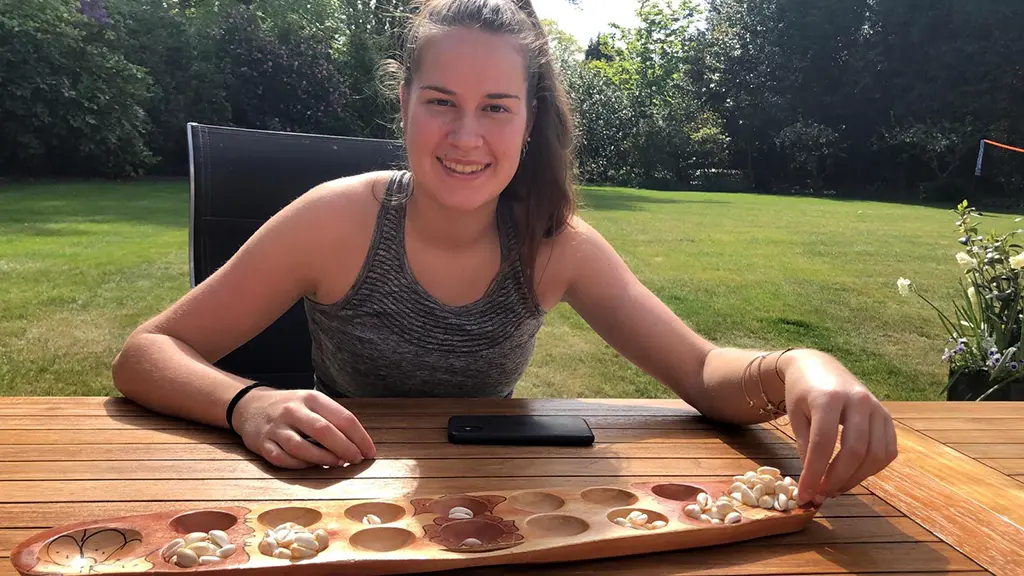
Little did I know that the Sungka that we played with our children in Asia was what is known as Warri in Barbados. One game: two different names (Warri in the Caribbean and Sungka in SE Asia), with similar rules. Warri is typically played using “horse-nicker” seeds (Caesalpinia bonduc) and Sungka is played using shells.
We made the Sungka:Warri connection on one of our recent visits to see family in Barbados. One of our traditions as a family is an island tour with my cousin William Burton. While visiting the Lion at Gun Hill we discovered a Warri board carved into the seat above the lion and reminisced about the children playing Sungka.

Rules of Warri

Warri is a strategy game. It is simpler to learn than chess and can be played at any level with great enjoyment.
Although Warri is deceptively simple, it is based on counting skills. To play competitively requires serious concentration and it is a test to ones intellect say some of the old time Barbados Warri masters. Mastery at competitive levels, calls for mathematical evaluation, mental recall and subtle planning. This makes Warri not only a great pastime but a formidable tool for teaching planning skills and general problem solving.
Warri’s technical integrity as a game of skill sets it squarely among the world’s finest strategy games – what a great heritage Barbados has but one that is quickly becoming extinct!
To play Warri, two players sit facing each other across a rectangular board with two rows of six depressions ranged along each side, called houses.
Warri is played with 48 seeds. Four seeds (usually Guilandina tree seeds “horse-nickers”) are loaded in each of the twelve houses.
Warri is a game of capture, so the winner of the game is the player that that captures captured 25 or more seeds.
A draw is declared if both players capture 24 seeds. In a tournament, the first player to win six games is the champion.
Once it is decided who opens the game, the players take make their moves alternately. In a move or cut, the player lifts all the seeds from any one of the six houses that are on his/her side of the board, leaving that house empty, and redistributes or “sows” the seeds by placing one seed into each house to the right of the chosen house, without skipping any of the houses along the row.
If the player still has seeds in hand when the redistribution reaches the rightmost house on the player’s side, he/she continues sowing seeds one by one into the houses on the opponent’s side of the board continuing the counter-clockwise cycle around the board until the seeds in hand are exhausted. In a move or cut therefore, the player repositions all of the seeds from one of his/her houses into the houses that follow along an anticlockwise path around the board.
A player may only move from a house on his/her side of the board
There is no limit to the number of seeds you may accumulate in a house. (In fact it is a good strategy to “build a house”. The trick is to know the right moment to break it!) When a player chooses to move from a house that contains more than eleven seeds, the distribution of the seeds will go a full lap around the board and commence a second lap but he must skip the house from which the move was started. The house from which a move was started should therefore always end up being an empty house after that play.
When a house contains a count of one (1) or two (2) seeds, it is said to be “vulnerable”, and when a vulnerable house occurs on the opponent’s side of the board, there is an opportunity for the player to make a capture. In order to take advantage of this opportunity, the player must make his/her move from a house that contains precisely the number of seeds, so that the last seed in the move comes to fall in the vulnerable house. If such a move is possible, the player claims the contents of the vulnerable house as well as the seed that was added in the capturing move. The total prize for the capture of a single vulnerable house will therefore be two (2), or three (3) seeds. These are removed from play and stored with the players other captures.
If there was another vulnerable house just before the captured house, its contents are also automatically seized by the capturing move. So too are the seeds in any other vulnerable houses preceding the point of capture as long as they formed an unbroken string of vulnerable houses connected to the captured house.
A player may only make a capture from a vulnerable house on the opponent’s side of the board.
There is a penalty for leaving the opponent without seeds to move with. If the opponent’s side of the board has no seeds remaining on it when it is his/her turn to play, the player forfeits all of the remaining seeds on the board to the opponent! (Players should therefore always try to ensure that the opponent’s side has at least one seed with which to play. If a player has an opportunity to capture all of the seeds on the opponent’s side as can happen in a multiple house capture, he/she should be sure that the move will win more seeds than are lost in the penalty!)
If the game has been evenly contested, it might happen that only three or four seeds come to remain in play on the board. With this number of seeds, the two players can easily avoid any further losses. In the case where there are three or four endlessly circulating seeds, players agree to stop play and count the seeds they have captured. The player with the majority is given the game.
The first player lifts all four seeds out of any one of the houses on his side, and deposits one seed in each of the houses that lie in sequence in a counter-clockwise direction. Repositioning seeds one by one faithfully in contiguous houses (without skipping any!) comprises a “move”. The opponent then makes his move.
In order to make a capture, a player uses his turn to choose a house which has accumulated the right number of seeds that when redistributed as described, allows the last seed in hand to come to fall in a “vulnerable” house on the opponent’s side – one that contains only one seed or two seeds. He will then remove them and add to his collection of captures. The player may only move from his side and may only capture as described on the opponent’s side. The costs and benefits of each move calls for constant situational analysis. There are no luck factors in Warri. No pulling of cards or tossing of dice.
Like chess and drafts, Warri is a mind game – a game won entirely by players’ strategic positioning.
As W Lee Farnum-Badley says:
“All games of strategy encourage evaluation for decision-making, and a decision is assuredly the most important survival skill. Hand-eye coordination, numeracy, forward planning, concentration, compliance with rules, turn-taking, decorum both in defeat or victory, and perseverance are all vital skill-sets that Warri fosters in young players.”
W Lee Farnum-Badley
Memories of Warri masters at play…
Can you remember when you last saw Warri being played in Barbados?
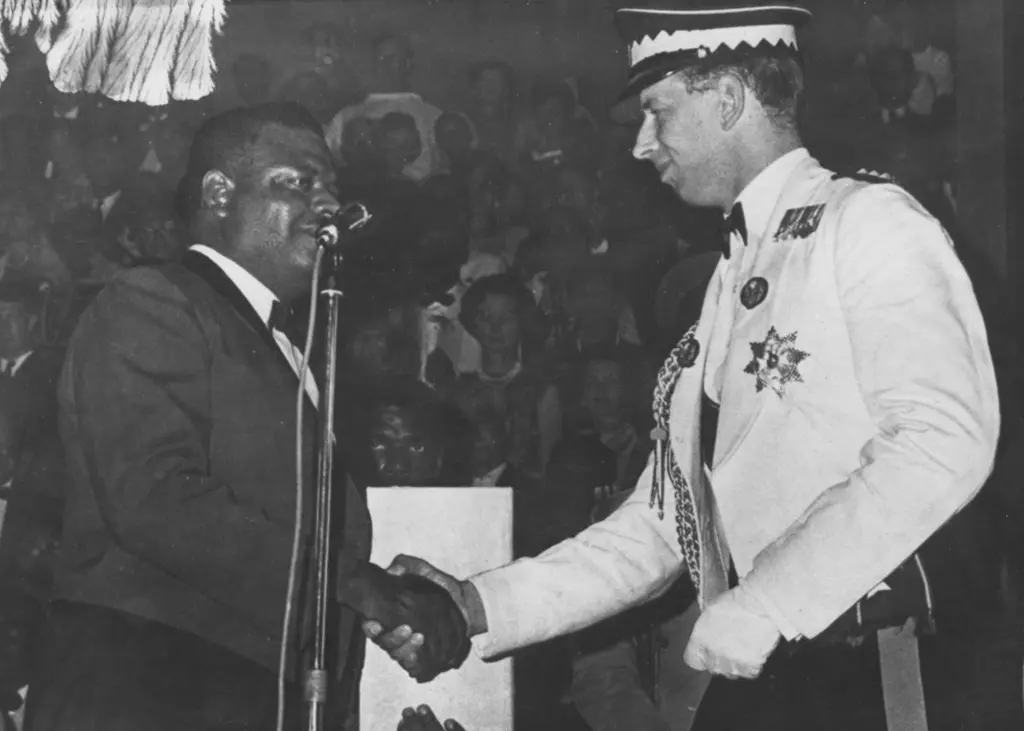
Some old photos Warri masters.
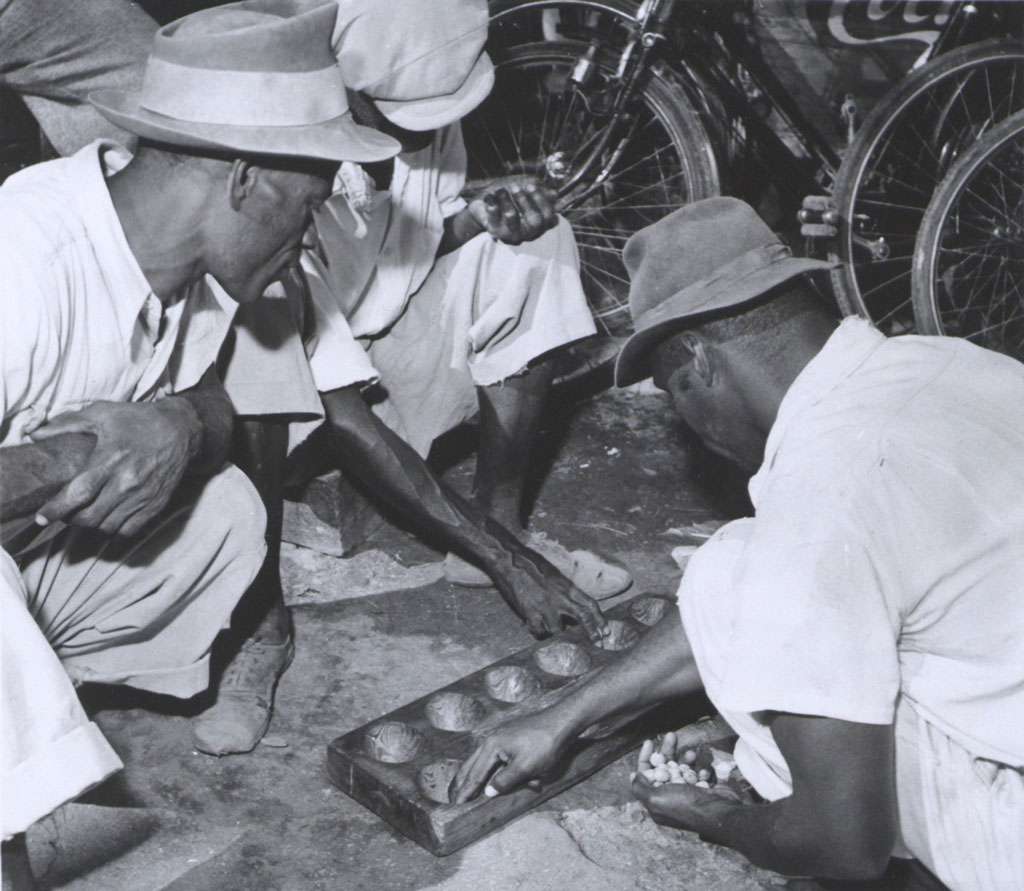


Are we right in concluding the playing of Warri in Barbados is now nearing extinction?
Further information on Warri:
- Why Warri by Valerie Jones, Caribbean Resilience (1 May 2020), Issue 6 (Summer 1993)
- Barbados Warri
- Barbados Warri: the Bajan way – W Lee Farum-Badley
- WARRI – The most ancient of games from Antigua & Barbuda THE CITIZEN
- Things That Matter: Warri – Intangible Culture, Our Culture by Sir Henry Fraser
- Mancala: Games That Count by Alex de Voogt
- Distribution of mancala board games: amethodological inquiry by Alexander J. de Voogt
- Seeded Players. The East African Game of bao Test the Limits of the Human Mind by Alex de Voogt – Journal of Natural History 2/98
- The Name of the Game: Oware as Men’s Social Space from Caribbean Slavery to Post-Colonial Times by Richard W. Stoffle & Mamadou A. Baro
- Warri’s Warriors: From West Africa to Barbados, Men’s Social Space from Slavery to Post-Colonial Times by Richard W. Stoffle, Mamadou A. Baro and Alissandra Cummin, Published in The Journal of the Barbados Museum & Historical Society − Vol. LXV
- African Mathematics. From Bones to Computers by Abdul Bangura
- Gizzard Stones, Wari in the New World, and Slave Ships by Jerome S. Handler 2009
- Battle of wits: Antiguans revel in ancient board game – BBC
- Warri press-cuttings courtesy of Barbados Museum & Historical Society
Our thanks to
- Harriet Pierce, the Librarian at the Barbados Museum & Historical Society who provided background papers on the game of Warri and Warri press cuttings and to
- Richard W. Stoffle who kindly sent us some of his papers on Warri.


Leave a Reply