

Lord Nelson’s statue – Bridgetown
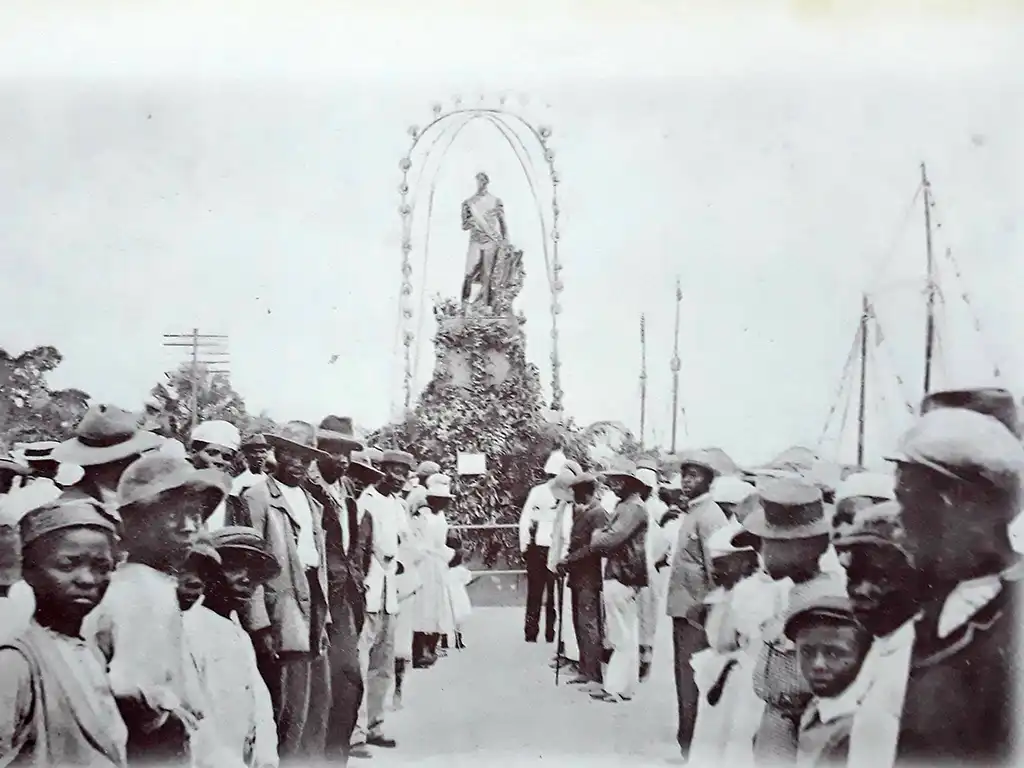
The statue of Admiral Lord Horatio Nelson in Barbados was unveiled in Bridgetown on 22nd March 1813. It was sculpted from bronze by Sir Richard Westmacott. It is considered an excellent likeness of the British Admiral.
Very soon after his victory and subsequent death at Cape Trafalgar in 1805, plans were made in Barbados to honour Horatio Nelson’s memory.
His popularity came because Bajan planters and merchants were very grateful and relieved not to become a French, West Indian colony, which would have been the alternative if Admiral Horatio Nelson had not gained victory for the British off Cape Trafalgar on the southern coast of Spain. This battle was the most decisive naval victory of the wars, ensuring British naval supremacy during the rest of the Napoleon Wars. It was also important for trade routes from Britain to Barbados.
The Battle of Trafalgar was fought on 21st October 1805, and was considered the most famous naval battle in history. It was where the Royal Navy led by Admiral Nelson devastated Napoleon’s combined Spanish and French fleet.
To show appreciation, a memorial service was held on 5th January 1806 at the St. Michael’s Parish Church (now St. Michael’s Cathedral), and within days Bajans were raising funds for a memorial statue. They then purchased the statue and land, naming it Trafalgar Square, paying tribute to the Admiral by erecting the statue.


For many years after, wreaths were laid at the statue on the anniversary of the Battle of Trafalgar (21st October).
The Barbados statue of Nelson pre-dates Nelson’s Column in Trafalgar Square, London by nearly 30 years.
Bajans proudly believe, mistakenly, they were the first to put up a monument to commemorate Lord Nelson. Barbados was actually the fourth place to do so, after: 1) Dublin (1809), 2) Montreal (1809), 3) Birmingham – Bull Ring (1809) which was also sculpted by Sir Richard Westmacott, 4) Bridgetown (1813) and finally London (1843).
This inaccuracy that the statue of Lord Nelson in Trafalgar Square, Bridgetown was the first such statue, was likely propagated by Sir Robert H Schomburgk in his book: History of Barbados published in 1847.
This square [Trafalgar Square], which was formerly called The Green, contains Nelson’s statue; and as this was the first monument erected to the memory of the immortal hero, the inhabitants of Barbados are proud of this priority.
Extract from page 245: The History of Barbados by Sir Robert H Schomburgk, published by Longman, Brown, Green, and Longmans 1847.
Lord Nelson public subscription list – Barbados Mercury, and Bridge-Town Gazette – Saturday 12th November 1808
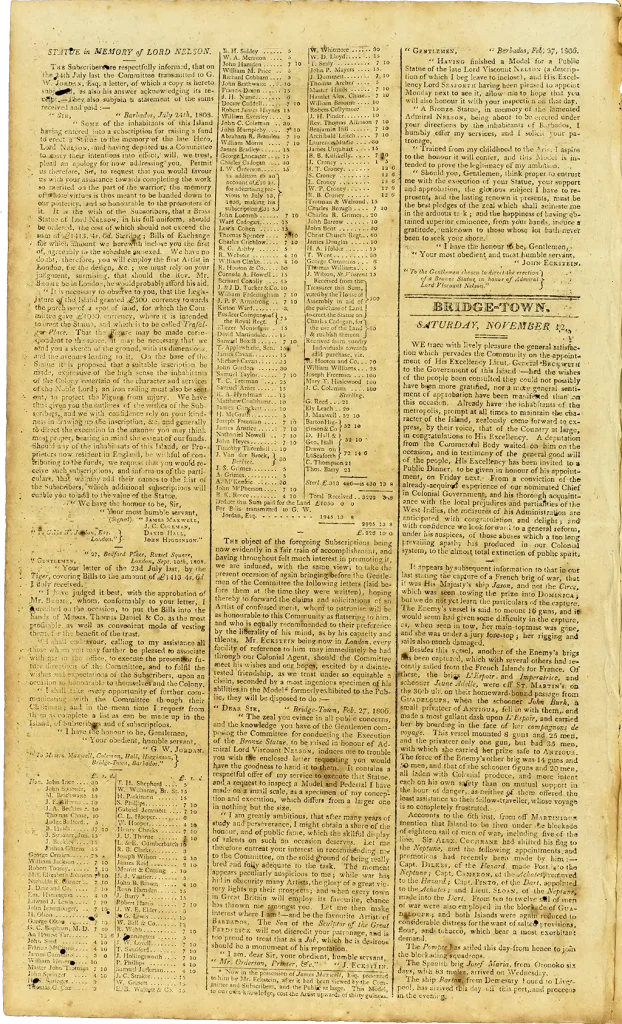
Below is a Transcript – Lord Nelson public subscription list: Barbados Mercury, and Bridge-Town Gazette – Saturday 12th November 1808, page 2:
STATUE in MEMORY of LORD NELSON
The Subscribers are respectfully informed, that on the 24th July last the Committee transmitted to G. W. JORDAN, Esq. a letter, of which a copy is hereto subjected, as also his answer acknowledging its receipt. They also subjoin a statement of the sums received and paid :—
Barbados, July 24th, 1808.
“SIR
Some of the inhabitants of this Island having entered into a subscription for raising a fund to erect a Statue to the memory of the late Hero, Lord NELSON, and having deputed us a Committee to carry their intentions into effect, will, we trust, plead an apology for now addressing you. Permit us therefore, Sir, to request that you would favour us with your assistance towards completing the work so merited on the part of the warrior, the memory of whose virtues is thus meant to be handed down to our posterity, and so honourable to the promoters of it. It is the wish of the Subscribers, that a Brass Statue of Lord Nelson, in his full uniform, should be ordered, the cost of which should not exceed the sum of £1,413. 4s. 6d. Sterling; Bills of Exchange for which amount we herewith inclose you the first of, agreeably to the schedule annexed. We have no doubt, therefore, you will employ the first Artist in London, for the design, &c.; we must rely on your judgment, surmising, that should the Rev. Mr. BROMME be in London, he would probably afford his aid.“It is necessary to observe to you, that the Legislature of the Island granted £500. currency towards
the purchase of a spot of land, for which the Committee gave £1,050 currency, where it is intended to erect the Status, and which is to be called Trafalgar Place. That the Figure may be made correspondent to the space, it may be necessary that we send you a sketch of the ground, with its dimensions, and the avenues leading to it.On the base of the Statue it is proposed that a suitable inscription be made, expressive of the high sense the inhabitants of the Colony entertain of the character and services of the Noble Lord; an iron railing must also be sent out, to protect the Figure from injury.
We have thus given you the outlines of the wishes of the Subscribers, and we with confidence rely on your kindness in drawing up the inscription, &c. and generally to direct the execution in the manner you may think most proper, bearing in mind the extent of our funds.
Should any of the inhabitants of this Island, or Proprietors now resident in England, be wishful of contributing to the funds, we request that you would receive such subscriptions, and inform us of the particulars, that we may add their names to the List of the Subscribers, which additional subscriptions will enable you to add to the value of the Statue.
We have the honour to be, Sir,
“Your most humble servant,
(Signed) JAMES MAXWELL,
J. C. COLAMAN,
DAVID HALL,
JOHN HIGGINSON”“To Gibbs W. Jordan, Esq. London.”
“27, Bedford Place, Russel Square, London, Sept. 10th, 1808.
“GENTLEMEN,
“Your letter of the 23rd July last, by the Tiger, covering Bills to the amount of £1,413. 4s. 6d I duly received.“I have judged it best, with the approbation of Mr. BROME, whom, conformably to your letter, I Consulted on the occasion, to put the Bills into the hands of Messrs. Thomas Daniel & Co. as the most profitable as well as convenient mode of vesting them, for the benefit of the trust.
I shall endeavour, calling to my assistance all those whom you may further be pleased to associate with me in the office, to execute the present or future directions of the Committee, and to fulfil the wishes and expectations of the Subscribers, upon an occasion so honourable to themselves and the Colony.
“I shall take every opportunity of further communicating with the Committee through their Chairman, and in the mean time I request from them as complete a list as can be made up in the Island, of Subscribers and of subscriptions.
“I have the honour to be, Gentlemen,
“Your obedient, humble servant,
“G. W. JORDAN.“Το Messrs. Μaxwell, Coleman, Hall, Higginson, Bridge-Town, Barbados.”
Subcriber £. s. d. Hon. John Ince 30 Hon. John Spooner 10 Hon. M. Brathwaite 15 Hon. J. F. Allevne 10 Hon. J. A. Beckles 10 Hon. Thomas Chase 10 Hon. Judge Bedford 6 Hon. B. Hinds 37 10 Hon. J. Spooner, Jun. 15 Hon. J. Beckles 15 Hon. Joshua Gittens 15 George Cruden 75 William Jackson 7 10 Robert Toosey 7 10 Mrs. Elizabeth Johnson 7 10 Nicholas R. Garner 7 10 J. Dear and Co. 7 10 Em. Harrington 4 10 Edward J. Lewis 7 10 John Ironmonger 7 10 H. Olton 6 George Olton 7 10 G. C. Bispham, M. D. 7 10 An Honest Tar 12 6 John Seed 4 10 Francis M’Clure 4 10 James Cummins 3 William Henery 10 Master John Trotman 7 10 John Springer 4 10 H. N. Springer 3 Thomas G. Cox 3 T. H. Shepherd 5 W. Williams, Br. St. 15 H. Parkinson 15 S. Phillips 7 10 Gabriel Jemmott 7 10 C. L. Hooper 6 W. Hooper. 4 10 Henry Cheeks 7 10 J. U. Thorne 7 10 L. & E. Curnberbatch 10 R. B. Clarke 3 Joseph Wilson 2 10 James Reid 2 10 Merritt & Cutting 10 J. J. Vautier 5 John B. Brown 4 10 Renn Hamden 15 J. Barry 15 Robert Harris 7 10 J. W. E. Elder 3 J. G. Lewis 15 W. Ball & Co. 15 R. Webb 7 10 J. Pennington 5 J. W. Lovell 7 10 T. Sandford 7 10 J. Hollingsworth 7 10 P. Phillips 4 10 Samuel Jackman 4 10 J. C. Straker 15 W. Grasett 15 E. B. Walcott & Co. 15 R. H. Siddley 5 W. A. Merriton 5 John Hamden 7 10 William M. Price 5 Richard Cobham 5 John Brathwaite 10 Francis Dixon 15 J. H. Nurse 6 Doctor Caddell 7 10 Robert James Haynes 15 Willian Eversley 5 John C. Coleman 30 John Humpleby 7 10 Abraham R. Brandon 7 10 William Morris 7 10 James Bradley 15 George Lancaster 15 Charles Cadogan 30 L. W. Orderson in addition to an account of £16. 5s. for advertising previous to 13 July 1806, making his subscription £31. 5s. 15 John Lucomb 7 10 Ward Cadogan 15 Lewis Cohen 15 Thomas Spencer 7 10 Charles Crichlow 7 10 R. C. Ashby 5 R. Webster 4 10 William Clarke 4 10 R. Hooton & Co. 30 Conrade A. Howell 15 Bernani Conolly 15 J. & J.D. Tucker & Co. 10 William Foderingham 7 10 J. P. F. Armstrong 7 10 Kirton Ward 3 Fusileer Company of the the Royal Regt. 75 Eliezer Montefipre 15 David Martindale 15 Samuel Boxill 7 10 T. Applewhaite, Sen. 15 James Cavan 15 Michael Cavan 15 John Gordon 30 Samuel Taylor 7 10 T. C. Trotman 25 Samuel Ames 15 R. A. Hyndman 15 Matthew Coulthurst 10 James Clingkett 10 H. McGrath 5 Joseph Freeman 7 10 James Anstice 7 10 Nathaniel Nowell 7 10 John Heyes 7 10 Timothy Thornhill 10 J. Van der Broek, Berbice 30 J. S. Grimes 5 A. Grimes 5 A. McKenkie 30 John McPherson 7 10 B. K. Reece. 4 10 w. Whitmore 30 W. D. Lloyd 15 T. Sealy 7 10 John P. Mayers 15 J. Dummett 7 10 Thomas Archer 5 Master Hinds 7 10 Hamlet Alex. Chase 7 10 William Broome 10 Robert Collymore 15 J. H. Pinder 10 Rev. Thomas Allinson 7 10 Benjamin Ifill 7 10 Archibald Leitch 7 10 Laurence Mudie 30 James Urquhart 15 B. B. Killikelly 7 10 J. Croney 1 5 J. T. Croney 12 6 S. Croney 12 6 L. Croney 12 6 W. P. Croney 12 6 R. B. Croney 12 6 Trotman & Walrond 15 Charles Brough 7 10 Charles R. Grimes 20 John Barrow 10 John Bent 30 Christ Church Regt 60 James Douglas 10 H. A. Holder 15 T. Went 30 George Cummins 6 Thomas Williams 5 J. Wilson, St. Vincent 15 Received from the Treasurer this Sum, voted by the House of Assembly in aid of the purchase of Land to erect the Statue on 500 Charles Cadogan, for the use of the Land & rubbish thereon 60 Received from sundry Individuals towards said purchase, viz. R.Hooton and Co. 70 William Williams 25 Joseph Freeman 100 Mary T. Haslewood 100 J. C. Coleman 100 G. Reed. 21 Ely Leach 20 J. Maxwell 52 10 Barton Higginson & Co 52 10 D. Hall & Geo. Hall 52 10 Drawn on Ld Seaforth 72 14 6 C. Thompson 21 Thos. Barry 21 Sterl. £3,134. 6s.-is £430. 13s. 8d. TOTAL RECEIVED 3,222 3 8 Deduct this Sum Paid for the Land -1,050 For Bills transmitted to G. W. Jordon, Esq. -1,945 13 8 Total Deductions -2,995 13 8 Funds in hand 226 10 0 Editors note: We are unsure what: Sterl. £3,134. 6s. – is £430. 13s. 8d. which appears at the bottom of the subscribers listing relates to?
We have shown the Total Received amount of: £3,222 3. 4s. 8d. The summation of the table differs from the £3,222 3. 4s. 8d. shown. This might be due to typos in the newspaper? Our summation of the subscribers is in the right ball-park and amounts to: £3,082. 14s. 6d.
THE object of the foregoing Subscriptions being now evidently in a fair train of accomplishment, and having throughout felt much interest in promoting it, we are induced, with the same view, to take the present occasion of again bringing before the Gentlemen of the Committee the following letters (laid before them at the time they were written), hoping thereby to forward the claims and solicitations of an Artist of confessed merit, whom to patronise will be as honourable to this Community as flattering to him, and who is equally recommended to their preference by the liberality of his mind, as by his capacity and talents.
Mr. ECKSTEIN being now in London, every facility of reference to him may immediately be had through our Colonial Agent, should the Committee meet his wishes and our hopes, excited by a disinterested friendship, as we trust under so equitable a claim, seconded by a most ingenious specimen of his abilities in the Model* formerly exhibited to the Public, they will be disposed to do:-
* Now in the possession of James Maxwell, Esq. presented to him by Mr. Eckstein, after it had been viewed by the Committee and Subscribers, and the Public at large. This Model, to our own knowledge, cost the Artist upwards of thirty guineas.
“Bridge-Town, Feb. 27th, 1806.
“DEAR SIR,
“The zeal you evince in all public concerns, and the knowledge you have of the Gentlemen composing the Committee for conducting the Execution of the Bronze Statue, to be raised in honour of Admiral Lord Viscount Nelson, induces me to trouble you with the enclosed letter requesting you would have the goodness to hand it to them.It contains a respectful offer of my service to execute that Statue, and a request to inspect a Model and Pedestal I have made on a small scale, as a specimen of my conception and execution, which differs from a larger one in nothing but the size.
I am greatly ambitious, that after many years of study and perseverance, I might obtain a share of the honour, and of public fame, which the skilful display of talents on such an occasion deserves. Let me therefore entreat your interest in recommending me to the Committee, on the solid ground of being really bred and fully adequate to the task. The moment appears peculiarly auspicious to me; while war has hid in obscurity many Artists, the glory of a great victory lights up their prospects; and when every town in Great Britain will employ its favourite, chance has thrown me amongst you. Let me then make interest where I am! – and be the favourite Artist of BARBADOS. The Son of the Sculptor of the Great FERDERICK will not discredit your patronage, and is too proud to treat that as a Job, which he is desirous
should be a monument of his reputation.“I am, dear Sir, your obedient, humble servant,
“J. ECKSTEIN.“To Mr. Orderson, Printer, &c.”
Barbados, Feb. 27th, 1806.
“GENTLEMEN,
“HAVING finished a Model for a Public Statue of the late Lord Viscount NELSON (a description of which I beg leave to inclose), and His Excellency Lord SEAFORTH having been pleased to appoint Monday next to see it, allow me to hope that you will also honour it with your inspection on that day.“A Bronze Statue, in memory of the lamented Admiral NELSON, being about to be erected under your directions by the inhabitants of Barbados, I humbly offer my services, and I solicit your patronage.
“Trained from my childhood to the Arts, I aspire to the honour it will confer, and this Model is intended to prove the legitimacy of my ambition.
“Should you, Gentlemen, think proper to entrust me with the execution of your Statue, your support and approbation, the glorious subject I have to represent, and the lasting renown it presents, must be the best pledges of the zeal which shall animate me in the arduous task; and the happiness of having obtained superior eminence, from your hands, induce a gratitude, unknown to those whose lot hath never been to seek your shore.
“I have the honour to be, Gentlemen
Your most obedient and most humble servant,
“JOHN ECKSTEIN“To the Gentlemen chosen to direct the erection of a Bronze Statue in honor of Admiral Lord Viscount Nelson.”
Barbados Mercury, and Bridge-Town Gazette – Saturday 12th November 1808, page 2
Lord Nelson Statue unveiling – Barbados Mercury, and Bridge-Town Gazette – Tuesday 23rd March 1813
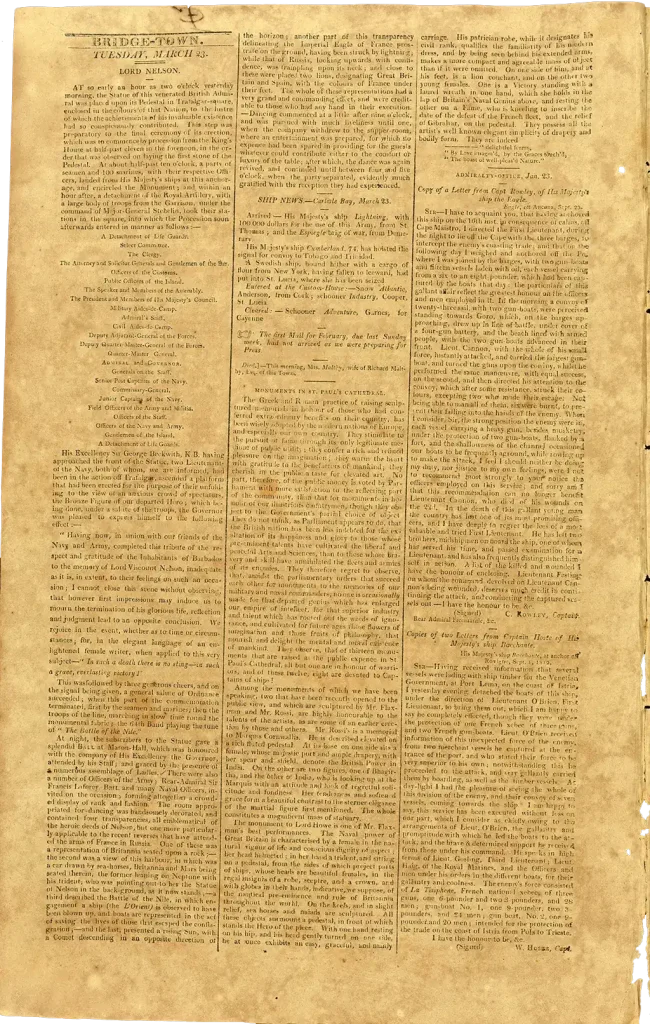
Below is a Transcript – Statue of Lord Nelson unveiling: Barbados Mercury, and Bridge-Town Gazette – Tuesday 23rd March 1813, page 2:
LORD NELSON
AT so early an hour as two o’clock yesterday morning, the Statue of this venerated British Admiral was placed upon its Pedestal in Trafalgar Square enclosed in the colours of that Nation, to the lustre of which the achievements of his invaluable existence had so conspicuously contributed. This step was preparatory to the final ceremony of its erection, which was to commence by procession from the King’s House at half-past eleven in the forenoon, in the order that was observed on laying the first stone of the Pedestal.
At about half-past ten o’clock, a party of seamen and 100 marines, with their respective Officers, landed from His Majesty’s ships at this anchorage, and encircled the Monument; and, within an hour after, a detachment «f the Royal Artillery, with a large body of troops from the Garrison, under the command of Major-General Stehelin, took their stations in the square, into which the Procession soon afterwards entered in manner as follows;—
A Detachment of Life Guards.
Select Committee.
The Clergy.
The Attorney and Solicitor Generals and Gentlemen of the Bar.
Officers of the Customs.
Public Officers of the Island.
The Speaker and Members of the Assembly.
The President and Members of His Majesty’s Council.
Military Aides-de-Camp.
Admiral’s Staff.
Civil Aides-de- Camp.
Deputy Adjutant-General of the Forces.
Deputy Quarter-Master-General of the Forces.
Quarter-Master General.
ADMIRAL and GOVENOR.
Generals on the Staff.
Senior Post Captains of the Navy.
Commissary-General.
Junior Captain’s of the Navy.
Field Officers of the Army and Militia,
Officer’s of the Staff.
Officers of the Navy and Army.
Gentlemen of the Island.
A Detachment of Life Guards.His Excellency Sir George Beckwith, K.B. having approached the front of the Statue; two Lieutenants of the Navy, both of whom, we are informed, had been in the action/off Trafalgar, ascended a platform that had been erected for the purpose of their unfolding to the view of an anxious crowd of spectators, the Bronze Figure of our departed Hero; which being done, under a salute of the troops, the Governor was pleased to express himself to the following effect:—
“Having now, in union with our friends of the Navy and Army, completed this tribute of the respect and gratitude of the Inhabitants of Barbados to the memory of Lord Viscount Nelson, inadequate as it is, in extent, to their feelings on such an occasion; I cannot close this scene without observing, that however first impressions may induce us to mourn the termination of his glorious life, reflection and judgment lead to an opposite conclusion. We rejoice in the event, whether as to time and circumstances; for, in the elegant language of an enlightened female writer, when applied to’ this very subject — “In such a death there is no sting – in such a grave, everlasting victory”.
This was followed by three generous cheers, and on the signal being given, a general salute of Ordnance succeeded; when this part of the commemoration terminated, first by the seamen and marines; then the troops of the line, marching in slow tine round the monumental fabric; the 64th Band playing the tune of “The Battle of the Nile”.
At night, the subscribers to the Statue gave a splendid BALL at Mason-Hall, which was honoured with the company of His Excellency the Governor, attended by his Staff; and graced by the presence of a numerous assemblage of Ladies. There were also a number of Officers of the Army; Rear-Admiral Sir Francis Laforey, Bart. and many Naval Officers, invited on the occasion; forming altogether a crowded display of rank and fashion.
The room appropriated for dancing was handsomely decorated, and contained four transparencies, all emblematical of the heroic deeds of Nelson, but one more particularly applicable to the recent reverses that have attended the arms of France in Russia. On one of these was:
– a representation of Britannia seated upon a rock;
– the second was a view of this harbour, in which was a car drawn by sea-horses, Britannia and Mars being seated therein, the former leaning on Neptune with his trident; who was pointing out to her the Statue of Nelson in the back-ground, as it now stands;
– a third described the Battle of the Nile, in which engagement a ship (the L’Orient) is observed to have been blown up, and boats are represented in the act of saving the lives of those that escaped the conflagration;
—and the last, presented a rising Sun; with a Comet descending in an opposite direction of the horizon;
another part of this transparency delineating the Imperial Eagle of France prostrate on the ground, having been struck by lightening; while that of Russia, looking upwards with confidence, was trampling upon its neck; and close to these were placed two lions, designating Great Britain and Spain, with colours of France under their feet.The whole of these representations had a very grand and commanding effect, and were creditable to those who had any hand in their execution.
Dancing commenced at a little after nine o’clock, when the company withdrew to the supper-room, where and entertainment was prepared, for which expense had been spared in providing for the guests whatever could contribute either to the comfort or luxury of the table; after which the dance was again revived, and continued until between four and five o’clock, when the party separated, evidently much gratified with the reception they had experience.
Barbados Mercury, and Bridge-Town Gazette – Tuesday 23rd March 1813, page 2
Removal of Nelson’s Statue, Bridgetown – 16th November 2020
Since the 1990s Nelson’s statue has been targeted for removal by successive Barbados administrations, because it is said that Nelson did not like Barbados and that he supported the slave trade upon which Barbados’ plantation economy was based.
Editors note: In October 2020, it was conclusively proven that the criticism of Lord Nelson’s alleged support for slavery was based on a forged letter.
The letter written by Lord Nelson in 1805 to Jamaican slave owner Simon Taylor, was altered after Nelson’s death at Trafalgar. Pro-slavery campaigners made 25 changes to the letter and published it in 1807 to sway opinion ahead of the vote to abolish the slave trade.
Horatio Nelson’s original letter to Simon Taylor is lost, presumed destroyed but, unknown to the anti-abolitionists, the Admiral had kept a ‘pressed’ copy — a sort of early carbon copy — in his rarely-seen private files, which are now in the British Library.
For more than 200 years, the forged Nelson-Taylor version of the letter was accepted as authentic until the pressed copy of the letter was cross checked against a copy of the forged letter that was found in a private collection in 2017. Sadly, by that time, significant reputational damage had been done to Nelson, with some labelling him a ‘white supremacist,’ ‘racist,’ and ‘pro-slavery’ based on the falsified document.
Further details can be found at the end of this post in the section: Additional Information.
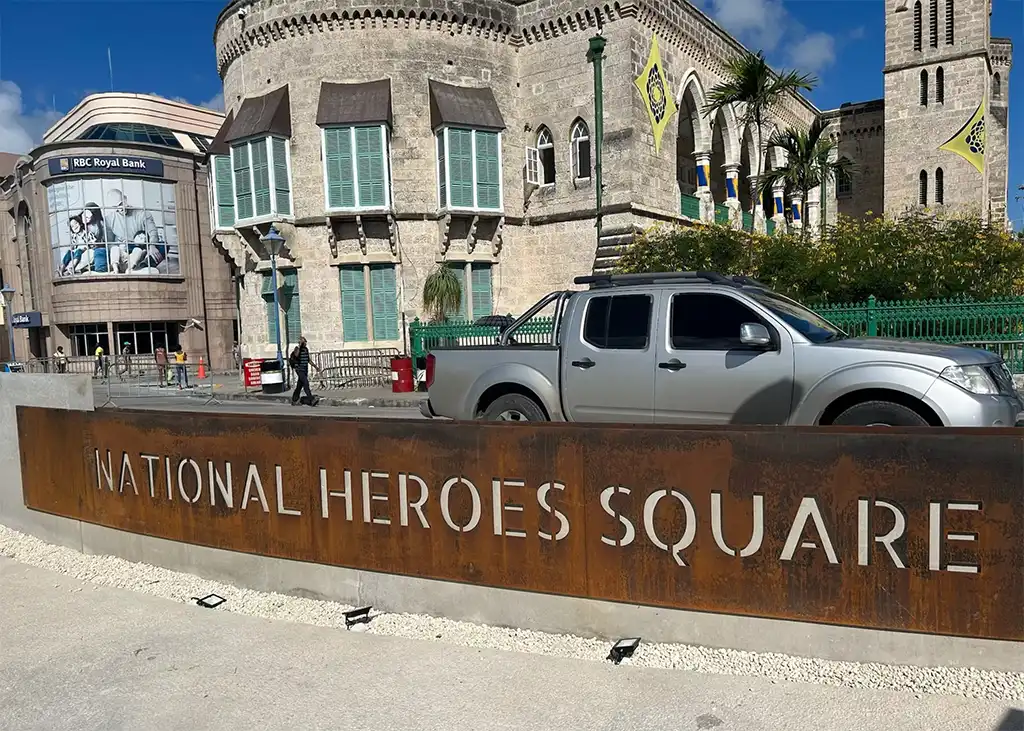
Trafalgar Square in Bridgetown was renamed National Heroes Square in April 1999. Since then the major changes have been the ceasing of the traditional wreath laying on the anniversary of the Battle of Trafalgar (21st October) and the change of direction in which Nelson now faces.

On 29th November 2017, on the eve of independence celebrations, activists splashed paint on the Nelson and added a sign in front of the statue that read:
“Nelson Will Fall. This racist, white supremist, who would rather die than see black people free, stands proudly in our nation’s capital. Nelson must go!! Fear not Barbados. The people have spoken. Politicians have failed us! Happy Independence”
In late May and June 2020 following the lead in the USA of the #BlackLivesMatter movement and in the UK where the the statue of Edward Colston was toppled in Bristol and then symbolically tossed into the harbour, local Bajan activists renewed their call for the government to remove Nelson’s statue. On 20th July 2020 the Barbados Government announced its intention to relocate Nelson.
Nelson’s statue was removed from National Heroes Square in Bridgetown on Monday 16th November 2020 (International Day of Tolerance) and put into storage – probably never to be seen again!
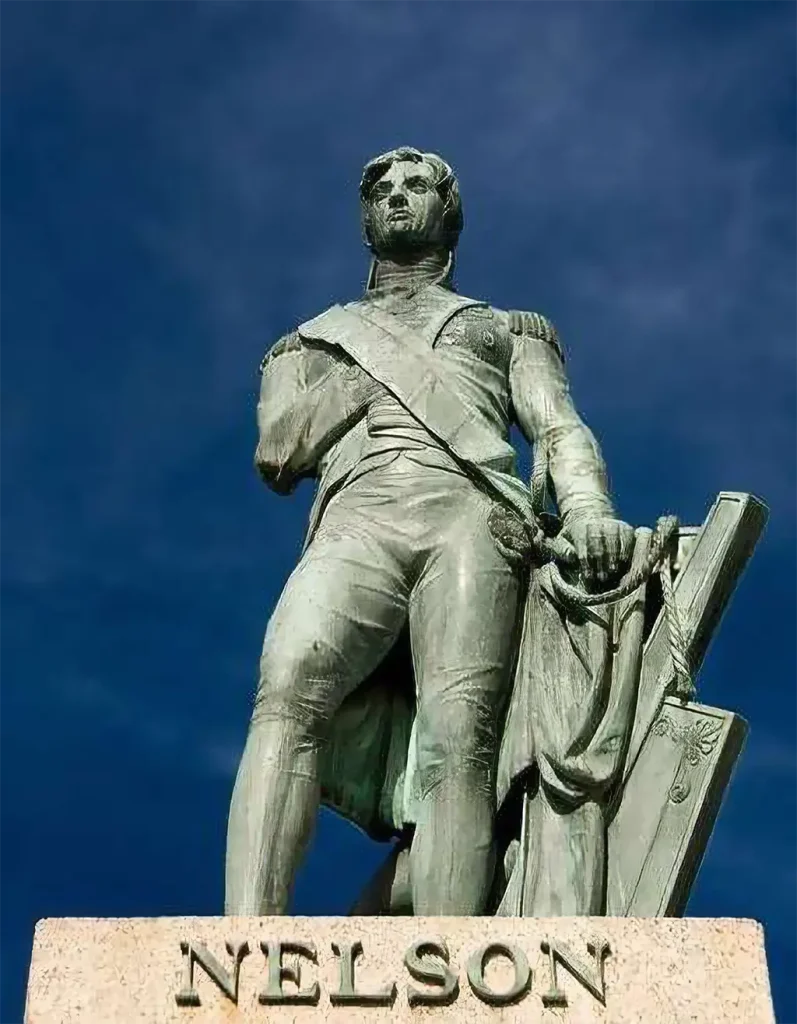


The removal of Nelson is Barbados’ latest symbolic break with its colonial past and comes two months after the Government of Barbados announced plans to replace Queen Elizabeth II as the head of state and and for the island to become the Republic of Barbados on the country’s 55th anniversary of its independence on 30th November 2021.
What will be removed next as The Republic of Barbados casts off its colonial past?
If Barbados is anything like Hong Kong—where I lived from 1997 to 2014 – its transition from British rule begun with symbolic changes. When Hong Kong was handed back to China in 1997 after over 150 years of British colonial rule, one of the first visible signs of change was the repainting of red post boxes green and the removal of all Royal crests. Where the Royal crests on post boxes could not be ground off, they were painted over with gloopy resinous paint!
Over time, another significant shift in Hong Kong was the gradual erosion of the ‘one country, two systems‘ framework. What was once a semi-autonomous city, became increasingly indistinguishable from other Chinese cities, as Beijing asserted direct control. This included the rewriting of Hong Kong’s colonial history and the imposition of sweeping National Security Laws by China.
Given the Barbados Government’s apparent willingness to court Chinese influence, it’s not unthinkable that the Republic of Barbados could become a Chinese strategic pawn, much like Hong Kong. In time, Barbados may too begin to revise its colonial past to align with new political realities. Is this the start of the realignment?
The good news is Barbados Post Boxes are still red and the Royal Crests remain!
Editor’s note: Aid and loans from China to Barbados do not come without influence. China’s influence on Barbados for example can be seen on how Barbados votes at the United Nations (UN). For example on 7th April 2022 Barbados abstained from a UN vote on suspending Russia from the Human Rights Council following Russia’s invasion of Ukraine. Barbados abstained and sided with China who support Russia.
And like other countries that have defaulted on their Chinese loans, China will look to exchange those loan notes for key infrastructure maybe the deep water harbour, the airport, and key tourist infrastructure that favour Chinese companies. Let’s see.
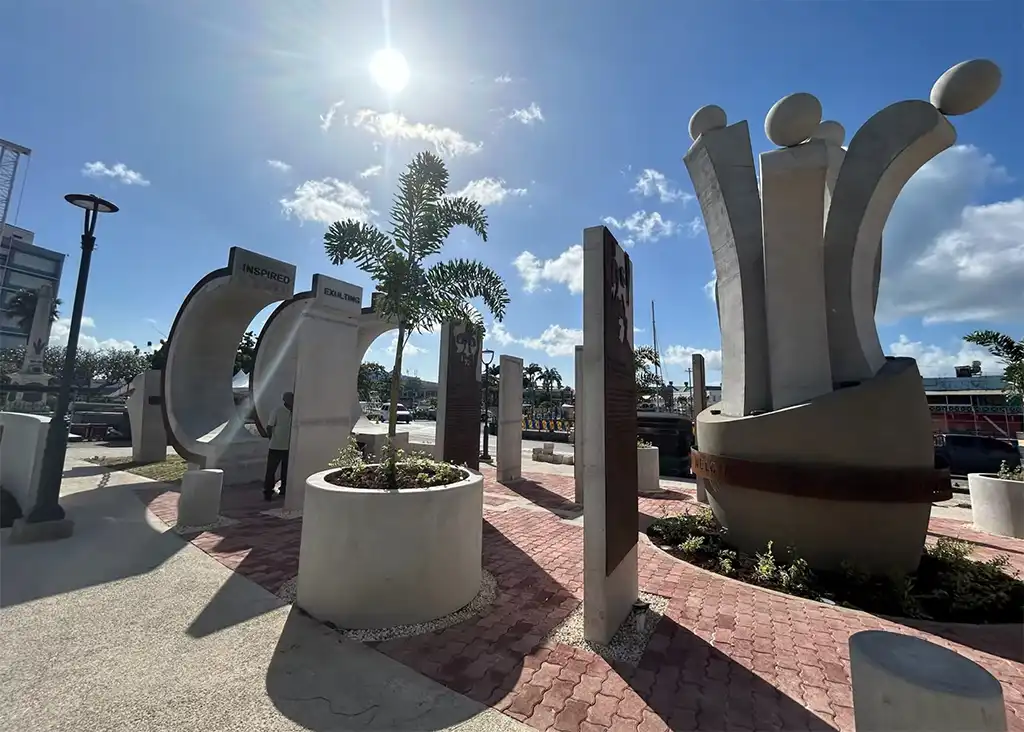
Nelson’s replacement – The Barbados National Heroes Square Monument by Hugh Holder and Vincent Jones called the Monument to the Barbadian Family
Where Nelson originally stood in what was Trafalgar Square has now been transformed into the National Heroes Square with a new sculpture by local designers: Hugh Holder and Vincent Jones called the Monument to the Barbadian Family. It was unveiled on 28th November 2023.
This new sculpture consists of large corten steel shackles that symbolised the struggle against slavery, while intricately lasered “steles” pay tribute to the eleven National Heroes of Barbados: Clement Osbourne Payne, Bussa, Dr. Charles Duncan O’Neal, Samuel Jackman Prescod, Ann Gill, Errol Walton Barrow, Sir Grantley Herbert Adams, Robyn Rhianna Fenty, Sir Garfield St. Auburn Sobers and Sir Hugh Worrell Springer.

A possible new home for Nelson
There is some social media chatter that as part of the new Bridgetown Pierhead Project the statue of Lord Nelson who was ceremoniously removed from National Heroes Square Bridgetown on Monday 16th November 2020 might be relocated to the open space at the tip of the pierhead.
A decision to relocate Nelson to the pierhead might now be easier given the Nelson-Taylor letter that the late Trevor Marshall used as compelling evidence that Nelson’s statue should be removed from Heroes Square in Bridgetown as he was a ‘white supremacist,’ ‘racist,’ and ‘pro-slavery’, has now been revealed to be a fabricated document, so totally undermining Marshall’s entire argument.
Lord Nelson’s column – London

The building of Nelson’s Column in London’s Trafalgar Square, began on 30th September 1840 and completed in 1843. The 56m (171 feet) high column is made from granite and features acanthus leaves, cast from British cannons at the top. At the very top stands a 5.5m (18 feet) statue of Nelson
The erection of this monument to Britain’s greatest Naval commander was the source of much delay and politicking. Originally conceived as a bronze statue the publicly subscribed fund could not afford this and so it was made of solid granite quarried from the estate of then Duke of Buccleuch, in Scotland.
The designer of this monument was a Mr William Railton and the sculptor a Mr E H Bailey. The pedestal is decorated with four bronze relief panels, each 18 feet (5.5 m) square, cast from captured French guns. They depict the Battle of Cape St. Vincent, the Battle of the Nile, the Battle of Copenhagen and the Death of Nelson at Trafalgar. The pedestal sculptors were Musgrave Watson, William F Woodington, John Ternouth and John Edward Carew respectively.
The four bronze lions on the base were added in 1867 and were designed by Sir Edwin Landseer.
Additional information
John Eckstein who was mentioned above in the Transcript – Lord Nelson public subscription list: Barbados Mercury, and Bridge-Town Gazette – Saturday 12th November 1808, page 2 was:
A painter who worked in England and the West Indies.
He exhibited at the Royal Academy in London between 1787 and 1802. In 1803 in his capacity as artist to Commodore Sir Samuel Hood he accompanied him to ‘Diamond Rock’ near Martinique. He then went to Barbados where he painted the portraits of officers stationed on the island.
In 1808 when a committee of inhabitants of Barbados publicly proposed erecting ‘a memorial to the memory of the late Hero, Lord Nelson’. John Eckstein was not slow in putting himself forward in two letters, one to the printers, the other to the Committee.
There was an inevitable delay in collecting subscriptions and although it seems as though he was at one point the preferred artist, the commission eventually went to Richard Westmacott.
John Eckstein profile – the Bartlett Maritime Research Centre at the National Maritime Museum Cornwall.
A description of Lord Nelson’s Statue in Bridgetown is given in the: History of Barbados by Sir Robert H Schomburgk first published in 1847 by Longman, Brown, Green, and Longmans, Paternoster Row, see page 245 – 247:
The official news of Lord Nelson’s victory and death reached Barbados on the 20th of December 1805. On the 23rd of December there was a brilliant illumination to celebrate the great victory, and a funeral sermon was preached on the 5th of January following, in St. Michael’s church, on the death of the hero.
A subscription was entered into for the erection of a statue to his memory in some conspicuous part of Bridgetown, and upwards of £2,300 was subscribed in the course of a few weeks.
The committee appointed for the execution of this plan had purchased “the Green” for £1,050, towards which sum the Legislature contributed £500. On this place, which was to be called Trafalgar Square, the statue was to be erected.
In July 1808 the disposable means for the erection of the statue amounted to £1,413 4s. 6d. sterling, which sum was transmitted to the agent of Barbados in London, with the desire from the subscribers that a bronze statue of Lord Nelson in his full uniform should be ordered for the above sum.
Various delays prevented the execution of this design until 1813. The first stone of the pedestal upon which the statue was to be erected was laid by Sir George Beckwith, assisted by Rear-Admiral Sir Francis Laforey, on the 24th of February: a plate of copper was placed in the cavity of the stone, with the following inscription:-
To the Memory of
HORATIO LORD VISCOUNT NELSON, K.B.,
Vice-Admiral of the White,
The Preserver of the British West Indies
In a moment of unexampled peril;
The Hero, whose various and transcendant merits,
Alike conspicuous in address, decision, action and achievement,
Throughout his whole unparalleled career of glory,
No powers of language can sufficiently delineate,
THIS STATUE
was erected by The grateful inhabitants of Barbados,
On a spot of ground appropriated to it
By a public grant of
The Colonial Legislature.
In accordance with the solicitations of a select Committee,
That so sincere though humble a tribute
Of esteem, admiration and gratitude to their
Illustrious Deliverer
Might be rendered more congenial
To his generous and exalted spirit,
From the hand of one,
Himself a Hero and a Benefactor to this country,
The first stone of the Pedestal was deposited by
His Excellency Lieutenant-General SIR GEORGE BECKWITH, К.В..
The Beloved and Patriotic Governor of Barbados,
And Commander of the Forces in the Leeward Islands,
February 24th, A.D. 1813.
Esto Perpetua!The statue was placed on the pedestal as early as two o’clock in the morning of the 22nd of March 1813. A large body of troops, under the command of Major-General Stehelin, took up their station in the square at ten o’clock, and soon after Sir George Beckwith and Admiral Laforey entered the square in procession, accompanied by the clergy, and the civil, military and naval authorities of the island.
Two lieutenants of the navy who had been in the action of Trafalgar, unveiled the statue, under the cheers of the assembled multitude, and a general salute of ordnance from St. Anne’s and the men-of-war in the bay.
The statue is surrounded with a neat iron railing, and represented in the position so usually adopted for Lord Nelson. Some unsightly houses obstructed the square, and partly for their purchase and removal, partly for other improvement of its appearance, the Legislature voted £2,000 in July 1826.
Extract from: History of Barbados by Sir Robert H Schomburgk first published in 1847 by Longman, Brown, Green, and Longmans, Paternoster Row . Page 245 – 247.
Nelson and the Slave Trade: A Position Statement by The Nelson Society The letter Lord Nelson penned to Jamaican plantation owner Simon Taylor in 1805 that The Nelson Society refers to was in October 2020 proved to have been forged. This forgery was created by anti-abolitionists soon after Nelson’s death at Trafalgar on 21st October 1805 to help keep the slavery trade alive and influence a Parliamentary vote on the abolition of slavery.
For context: The Slave Trade Act was passed on the 25th March 1807. It banned the purchase and sale of enslaved people in the British colonies. While this act did not immediately abolish slavery, it was a significant step toward ending the transatlantic slave trade.
Nelson’s original letter to Simon Taylor is lost, presumed destroyed but, unknown to the anti-abolitionists, Nelson had kept a ‘pressed copy’ in his rarely-seen private files, which are in the British Library.
Pressed copies were a sort of early carbon copy made using a specially designed machine to press damp tissue paper on to the original letter, giving a mirror image. This was then reversed so the text could be read through the tissue paper. This impression was then stuck on to light grey paper so that the text could be more clearly read.
For more than 200 years, the forged Nelson-Taylor version of the letter was accepted as authentic until the pressed copy of the letter was cross checked against a copy of the forged letter that was found in a private collection in 2017.
Comparing the pressed copy of the letter to Simon Taylor penned by Nelson while aboard HMS Victory on 10th June 1805 with the copy of the newly discovered forged document reveals that Taylor and his anti-abolitionist cronies made no fewer than 25 changes to Nelson’s original letter before they rushed it into print after the Admiral’s death to try and influence the vote in Parliament.
Sadly, the forged Nelson-Taylor letter became the catalyst for the passionate life mission of the late Trevor Marshall, a renowned Bajan historian and educator, who campaigned tirelessly for the removal of Nelson. The forged letter to Simon Taylor in Jamaica was presented incorrectly as key evidence that Nelson was a ‘white supremacist,’ ‘racist,’ and ‘pro-slavery’, a claim that many Bajans still believe.
Click here to read about the discovery of the forgery of the Nelson-Taylor letter by: The Nelson Society and by the lead researcher: Martyn Downer. or listen to his interview below:
Given this new evidence isn’t it now time to bring Nelson out of storage and display him in one of the courtyards of the Barbados Museum.
#BTColumn – Nelson, the mass-murderer – Part 4 – this article by Grenville Phillip which appeared in Barbados Today on 25th June 2020, addresses Trevor Marshall’s claim that Nelson was a mass-murderer of Barbadians, and David Comissiong’s claim that Nelson’s statue is keeping Bajans psychologically enslaved.
Special Thanks
Our thanks to Vincent Hayes – Facebook Group: Exploring Caribbean history for pointing us to the two Barbados Mercury, and Bridge-Town Gazette newspaper links which we have transcribed.
Update History
This post: Lord Nelson’s statue – Bridgetown, Barbados – was originally published on 13th May 2015. It was updated after Nelson was removed on 16th November 2020. It was updated again on 16th May 2025 with two extracts from the Barbados Mercury, and Bridge-Town Gazette: one from Saturday 12th November 1808, which list the public subscribers; one from Tuesday 23rd March 1813 which describes the unveiling of the statue of Nelson. Also included is an extract from the first edition of Sir Robert H Schomburgk’s History of Barbados published in 1847 that describes Nelson’s Bronze statue and how it was procured.


Leave a Reply