224 Squadron mechanics work on the 1,200 hp Pratt and Whitney turbo-supercharged R-1830 Twin Wasp radials while in the background another Liberator rolls up to the dispersal at RAF St Eval on the northwest coast of Cornwall. Photograph: Comox Air Force Museum dated February of 1944.
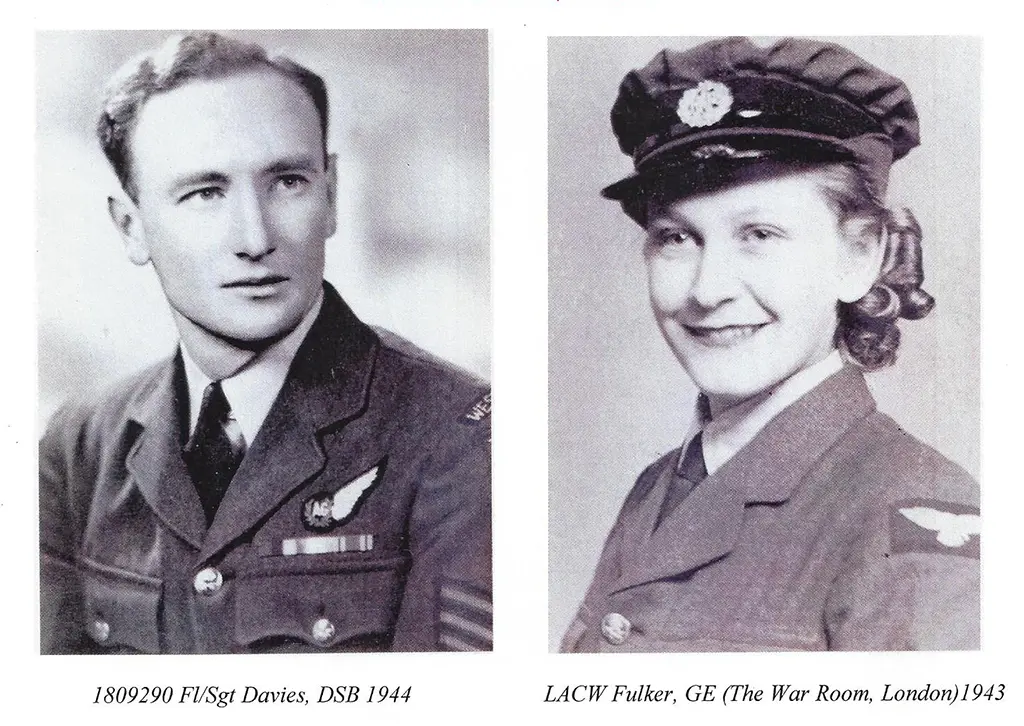
Derek Sewell Blackburn Davies joined the RAF on 3rd September 1942, serving for nine months in the RAF regiment. He received aircrew training as a specialist air gunner receiving his wing in April 1944 and was then posted to 224 Squadron, RAF Coastal Command joining the crew of F/L Merrington flying in B-24 Liberators hunting German U-boats in the North Sea and in the Atlantic.
He flew 35 operational sorties which included covering the D-Day landings to prevent U-boats and other units of the German navy from penetrating the main landing sites.
In November 1945 Derek was seconded to the Colonial Office in London to assist with the repatriation of other West Indian personnel back to their homelands serving with F/L Peter Bynoe, F/L Arthur Wint and S/L Ulric Cross. Derek was repatriated to Barbados arriving home on 24th December 1946 with his wife Gweneth. Later he received the Barbados Service Medal.
Mary Gleadall worked with Derek Davies at the Barbados Military Cemetery Association from about 1998 until late 2006. Derek gave her this copy of an interview between himself and Paul Foster. We believe it was published in The Advocate in July 2006.
Derek told Mary he was always so proud that he, a Bajan, had served with 224 Squadron, the Squadron which had sunk U-514, the submarine that on 11th September 1942 entered Carlisle Bay and torpedoed the CNS Cornwallis.
War Comes to Barbados – U-boat attacks shipping, Barbados Advocate Saturday 12th September 1942.
[U-514 was sunk on 8th July 1943 in the North Atlantic north-west of La Coruña, Spain, at 43.37N, 08.59W, by a RAF B-24 Liberator from 224squadron flown by S/L Terence Bulloch, one of the most decorated pilots in Coastal Command. All hands were lost when U-514 sunk.]
Bajan Gunner in RAF during World War II as told to PaulFoster
Part One: Early Days
What was it that made a 19-year-old Barbadian, just out of Harrison College in 1941 and into his first job with the Royal Bank of Canada, suddenly decide he was going to ‘join up’ and fight in a bloody war halfway around the world?
Derek Davies was the eldest of five children, four boys and a girl. He was the son of Harry Davies of Alfred Field of the UK. Alfred Field was a household name in those days in the West Indies and British Guiana. His father came to Barbados in 1920, to take up the position of Local Managing Director with CF Harrison & Co. Ltd., a subsidiary of Alfred Field & Co Ltd. CF Harrison’s of 1 Broad Street, Bridgetown sold general merchandise from nails, screws, bolts to furniture, haberdashery etc. His mother was the former Lucy Batson, whose father Henry Sewell Batson was a distiller of rum on Bay Street. The Batson’s are an old Barbados family who have been on the island since the early 1700’s.
Two photographs for CF Harrison & Co. Ltd. One from the early 20th century. One from the mid 20th century.
Davies remembers a former distiller telling him that the rum produced by Mr. Batson was affectionately known as Batson’s bitch. He said that some of Batson’s rum was still around in the 1970/1980s.
Advertisements
His primary education was at two private schools, one operated by Mrs. Bessie Walcott, located in Rockley and the other school at the Stream, Worthing run by a Mrs. Cummings.
In the early 1930’s, he was sent to Harrison College where he sat and passed all the entrance exams and was duly elected to begin his formal education in Preparatory Form A under the guidance of Miss Gardiner, assisted by “Ma Flopps” Phillips.
He admitted he was by no means a brilliant student, much to the dismay of his parents. He seemed to gravitate towards sport. He once remembered his mother telling him that Mr. Haskell, the Headmaster of Harrison College had told her that “if Derek put as much effort into his school work as he did in sports, he would be a good student.”
Davies said he was privileged to play for Harrison College First Eleven at both football and cricket as well as representing the school at the interschool sports on several occasions. He was a member of the ‘famous Harrison College Football Eleven of 1940’ which won all three Cups in the Island, defeating all the big guns like Spartan and Empire and of the 1941 team that won the Dalton School and Knock Out Cups. He said he must have taken after his father in soccer, who had represented the Liverpool School Boys (UK) for football many years before.”
He also played water polo for Whipporays and Flying Fish. He was a member of the Flying Fish team when it won the League cup in 1949.
Davies went on to represent Barbados at football on a few occasions after leaving Harrison College.
Davies takes up the story: “I left Harrison College in 1941 in the middle of a term as there was a vacancy at the Royal Bank of Canada.”
“Mr. Haskell recommended that I apply for the position after discussions with my father. I was duly interviewed by the Manager, Mr. Gilliatt and accepted… one day a student in Form 5Aand the next day a junior banker. I could not have been such a dumb student as I never missed a promotion when that time arose.”
“In late 1941, I applied to join the Royal Air Force and was granted extended leave by RBC with the guarantee of my job back, if so desired, as well as my salary, until such time as my RAF pay equalled it. No big deal, as my pay from RBC at that time was $400.00 per year or $33 .33 per month. BELIEVE IT OR NOT!
So, again the question arose, what made him decide to join up?
Davies said “it was probably due to the fact that his father’s country was under siege at the time, coupled with the fact that his mother’s sister was lost as well as many children, when the “SS City of Benares” was sunk on her way from Liverpool, England to Montreal, Canada by German U-boat U-48”
[Aunt Maud (nee Batson) was married to Lt. Col. Frederick Gustave Ameile Delisle Saphile Wooding Deane. She died aged 50 when the SS City of Benares was torpedoed by U-boat U-48 on 18th September 1940. Maud was sailing from Liverpool to Montreal with 90 evacuated children on their way to Canada to escape the German air attacks on Britain. 77 of those 90 evacuated children lost their lives when the SS City of Benares was sunk. U-48 that sunk the City of Benares with Derek Davies’ Aunt Maud on board was one of the highest scoring U-boats in the German submarine fleet with 52 kills.]
Davies was selected for RAF Air Crew training in late 1941 but was unable to leave Barbados due to lack of shipping until April 1942. Hewas scheduled to leave on the CNS Lady Nelson, but before arriving in Barbados she was sunk by a U-boat in Castries harbour, St. Lucia. He caught the next ship out, the CNS Lady Drake and the ship proceeded through the islands unescorted to Bermuda, where he was disembarked by the Military on arrival. Was it luck or fate again, as some hours after leaving Bermuda, the Lady Drake was sunk by U-boat U-106 some 90 miles south of Bermuda enroute to Boston with the loss of 12 lives.
[At 03.05 hours on 5th May 1942 the unescorted CNS Lady Drake (Master Percy A. Kelly) was hit by one of two torpedoes from U-106 and sank in 25 minutes about 90 miles north of Bermuda. Six crew members and six passengers were lost. The master, 114 crew members and 141 passengers were picked up by the USS Owl and landed in Bermuda.]
Survivors from the Drake landed in Bermuda and Davies went to where they were staying as he knew several of the survivors personally, among whom was Mr. Harold Wright. He was requested by Wright to send a cable to his wife indicating that he was alright.
Advertisements
The cable was to read: “Wright and Davis well”.
Mr. Davis was a friend of Mr. Wright and with little thought Davies sent the message. Of course, no one differentiated between ‘Davis and Davies’. This stirred up all sorts of rumours at home and took some time to sort it out.”
Davies eventually left Bermuda in the New Zealand trooper “HMT Awatea” in late July 1942 bound for Canada. He was again removed by the military and put on board the P&O liner “Strathmore”. He left Halifax in one of the largest and strongest protected convoys to date. However, the “HMT Awatea” was hit that night and had to return to port.
[The HMT Awatea was a New Zealand passenger liner requisitioned as a troopship during World War II, noted for carrying Canadian troops to Hong Kong in 1941 and participating in the Operation Torch landings in North Africa in 1942, where it was sunk by German aircraft on 11th November 1942.]
He eventually arrived in Gourock Scotland in late August and proceeded to Adastral House in London for medical tests etc.
[Adastral House was the headquarters of the Air Ministry during World War II and was in Aldwych, London.]
Davies was sworn in on 3rd September 1942 on the thirdanniversary of the outbreak of WW2. “Before I joined Aircrew,” he said, “I trained for six months or so with the RAF Regiment.”
“After that I was called up for training as an Air Gunner and received my ground training in many parts of England. My flying training etc was received in Northern Ireland and I eventually received my Wing in April 1944.”
While in Bermuda I was billeted with the Cameron Highlanders of the UK who were stationed there at the time. This was until luck would have it I met the Redman Family and was invited to spend with them what time I had left before onward transportation could be found. Mr. Redman was the brother of the gentleman of the same name who owned and operated a garage near Crumpton Street at the time.
It was wonderful to be in a home again and treated as one of the family. As opposed to sleeping on three biscuits and doing everything to the blast of a bugle or the wail of Bagpipes. The noise in the accommodation was beyond description as there were coming and goings of the soldiers all day and night
There is as far as I know only one member of the family alive today, Mona. She is married and has one son. One day some years ago my telephone rang, and I heard someone say” this is a voice from your past”. It was Mona on a cruise ship who had remembered me and where I lived. A great day was had by all.
“I was then sent on leave with orders to report to RAF St. Eval in Cornwall. On arrival I found that I had been posted to 224 Squadron Coastal Command for operational flying duties. I joined F/L Merrington’s crew along with a friend Jeff Wilkinson, another Specialist Air Gunner with whom I had trained in Northern Ireland. The date was May 1944.”
RAF Coastal Command 224 Squadron based at St. Eval, Cornwall flew the B-24 Liberator long-range aircraft to conduct maritime patrol, anti-submarine warfare and D-Day coverage.
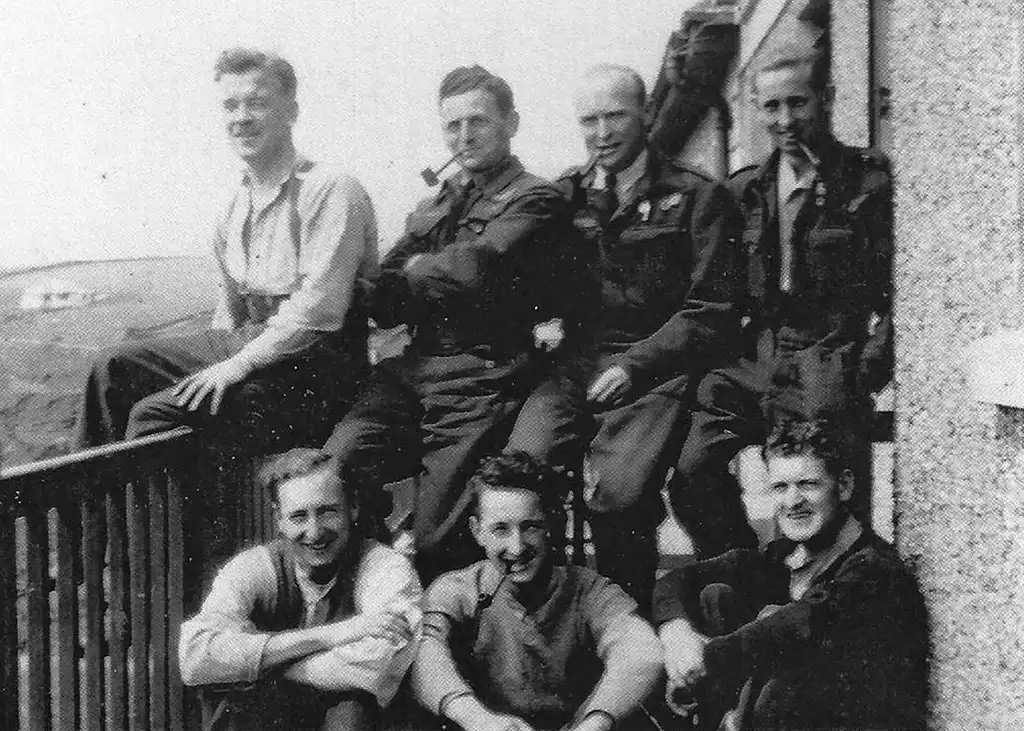
Derek Davies 224 Squadron crew.Back row: W/O Cousins, F/Sgt Clarke, F/Sgt Hall, W/O McCaul DFM, F/Sgt Davies (wearing his side arm) Front row: W/O Clarke; F/Sgt Templing, F/Sgt Wilkinson.
John Davies told us:
Advertisements
Dad is on the far right, wearing his side arm in a holster – we still have the holster. He also carried a rather nasty looking knife which he always said was to cut himself out of his parachute. I suspect it was for more than that!
John Davies
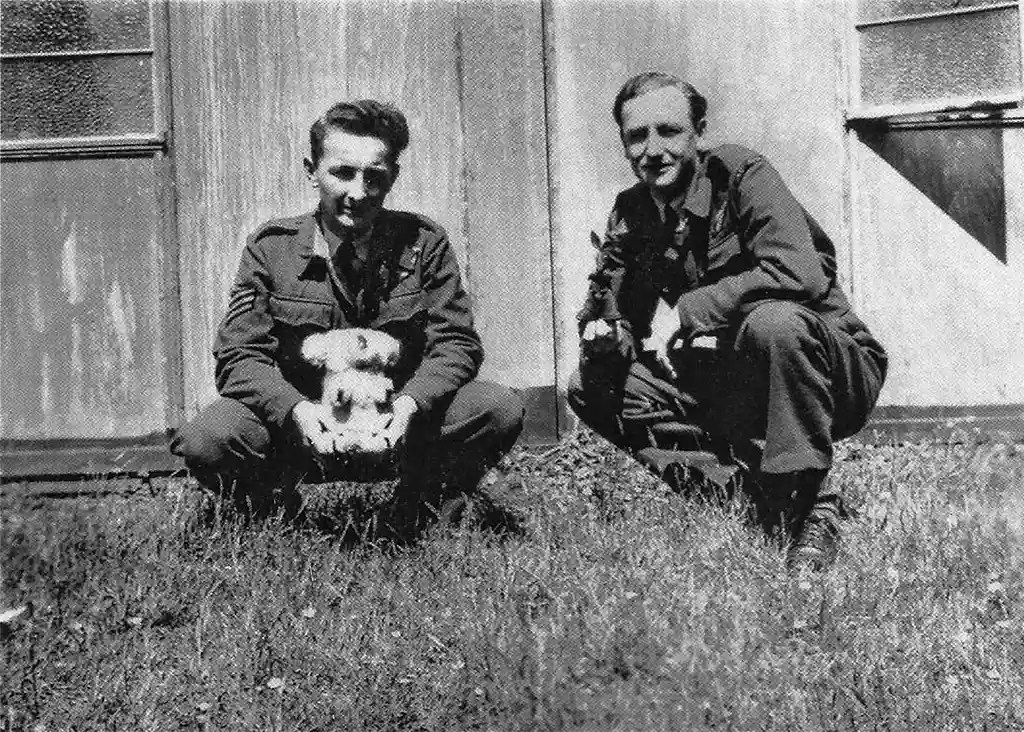
Derek Davies 224 Squadron crew: Back row: W/O Cousins, F/Sgt Davies, F/Sgt Wilkinson, F/Lt Merrington (Skipper), F/Sgt Clarke, F/O Vivian. Front row: F/Sgt Templing, W/O McCaul DFM, W/O Clarke, F/Sgt Hall.224 Squadron Coastal Command R.A.F. St. Eval Cornwall, 1944. Bedruthran Steps Hotel – our billets with pub attached! Back Row: Stan McCaul, DFM, Eddie Clarke, Bill Stewart, Les Templing Front Row: Derek Davies, Jeff Wilkinson, Tommy Cousins.224 Squadron Coastal Command RAF Milltown, Morayshire, Scotland 1944 Jeff Wilkinson & Derek Davies with ‘Koala Bear & Kangy’, our mascots who flew with us on every trip.224 Squadron Coastal Command RAF Milltown, Morayshire, Scotland 1944.
Derek Davies and Jeff Wilkinson standing on the left of the Port Wing.
The time is June 1944, and he was about to take part in the biggest event in his life. “My friend and Co Specialist, Air Gunner Jeff Wilkinson would decide before take-off, who would take the front or rear turret, to start the patrol, as both positions, were very important when attacking a U-boat or defending against fighters. These positions were the jobs of specialists and here is where our training came in. These turrets were hydraulically operated and moved 90 degrees to Port and 90 degrees to Starboard from the centre line. In both turrets were two .50 calibre machine guns and were similarly operated together in a downward or upward motion. These guns were armed with Tracer, Armour Piercing, explosive shells and were fed from two canisters, located on either side of the Aircraft outside of the two doors of the turret. Regarding the rear turret, the occupant had to lock himself in but for the front turret this was the job of the Bomb Aimer, who had also to let you out.”
“Our Operational Trips could last between 10 to 14 hours and due to the cold and cramped conditions within the turret we could arrange to change places, which at least gave you the opportunity to stretch your legs over the length of the aircraft and use the ‘Elson’ (toilet) if required. The trick was to negotiate the Bomb Bay without discharging the compressed air bottle on your Mae West, as each discharge cost ten shillings a refill which we had to pay for! Hard to believe, but true!”
224 Squadron were flying very long range “Liberators” or B-24’s, as our American friends knew them. These were four-engine aircraft, carrying approximately 2,500 gallons of fuel and crewed by a team of ten. They were heavily armed with two 0.5” calibre guns EACH in the nose turret, in the mid-upper position, on the beam, as well as in the tail turret. We also carried a load of eight depth charges of 250 pounds of explosive each.”
“Our Squadron covered the D-Day landings (June 1944) and our patrol area covered the English Channel, the Bay of Biscay and as far down as St. Nazaire, where all the German submarine pens were located. We were searching for submarines and blockade runners.”
“The squadron was made up of 136 Britons, 44 Canadians, 33 Australians, 8 New Zealanders, an American, a Swiss, a Chilean, a Brazilian, an Australian born Chinese, as well as me, a Barbadian.
A writer once described us, the Air Crew, “as an astonishing company.”
As D-Day approached 224 Squadron, based at St Eval under the Command of W/C TWT McComb OBE was ordered to carry out patrols in the Channel area. During the actual invasion operations, close escort was given to the swarm of ships and landing craft, as well as reconnaissance flights along the French Coast
“When D-Day 6th June 1944 arrived, our specific duty, along with other aircraft of RAF Coastal Command, was to seal off the Southwestern entrance to the English Channel to prevent U-boats and other units of the German Navy from entering the invasion area.
These were called “Stopper” or “Cork” patrols and lasted from nine to ten hours or more at times. These patrols were so laid out that they overlapped and covered an area from Brest in France to the southern tip of the British Isles and then out into the Bay of Biscay.”
“So aircraft protected the outer flank of the invasion area while the Navy took care of the inner flank. A similar pattern took place at the northeastern end of the Channel.”
“From Brest, that was itself a U-boat base, down along the French west coast there were the U-boat bases of La Pallice, Lorient (Base sous-marine de La Rochelle) and St. Nazaire. RAF Coastal Command Squadrons were there to prevent any access by the large number of U-boats based at these ports from reaching the D-Day invasion area.
“It was an interesting time,” said the modest Davies. “We remained at St.Eval until the powers that be decided that there was no further threat from subs in that area. The Squadron was then posted to Milltown, in northern Scotland, on the edge of the Moray Firth, in September 1944, where our duties were to cover the Western Baltic, Dutch and Norwegian coasts.”
“When the war in Europe ended in May 1945 we returned to St. Eval and subsequently we were sent to the Azores for three months rest prior to going out East. Fortunately the war in that area came to an abrupt halt in August 1945, after the Atom Bombs.”
The task of protecting the flanks of the invasion fleet was carried out efficiently and effectively. It needs no other attestation than the official statement issued by the Government of the day, that “only one ship MAY have been sunk by U-boat action”. There was no confirmation that a U-boat sank it, it may have struck a mine- but it was the only ship out of nearly 6000 that might possibly have been torpedoed by a U- Boat.
224 Squadron was an elite Squadron and was ranked among the top U-boat killers of RAF Coastal Command. An outstanding feat was performed on 8th June 1944 by a Canadian Captain, F/O Ken Moore and crew of 224 Squadron G-George when they sank the U-269and U-373 all within the space of thirty minutes. This was the first ever occasion in which a crew sank two U-boats in a single sortie. F/O Moore was immediately awarded the DSO, his navigator the DFC and Flight Engineer the DFM.
Advertisements
Another notable achievement was when on 8th July 1943 a Liberator of 224 Squadron sighted a U-boat amongst Spanish Trawlers in the Bay of Biscay. S/L Bullock DSO DFC and bar immediately attacked the U-boat with his Liberator aircraft. The U- Boat was seen to submerge only to reappear with its tail up and it eventually sunk with all hands. This U-Boat, the U-514 captained by Kapitanleutnant Hans JR Auffermann, was the same submarine that on 11th September 1942 had penetrated the anti-submarine nets stretched across Carlisle Bay, Bridgetown, Barbados and torpedoed the CNS Cornwallis that was anchored there.
At this point it would be unreasonable of me not to mention my crew. We were made up of 3 Australians, 1 New Zealander, 1 Scotsman, 5 Brits, and 1 Bajan.
Our Skipper was F/L Merrington DFC a most competent and unflappable pilot, who brought us home on the courses set by another Brit F/O Vivian, who never seemed to know where he was, but we always were dead on track and made Land fall at the designated point. The most experienced of us all was W/O McCaul DFM, a product of Bomber Command and senior Wireless Operator.
We lived, worked, and moved around as a team and it was a sad day when after nearly a year together we split up due to some being time expired and others to return home.
W/C MA Ensor DSO and bar DFC and bar AFC was commanding Officer while the Squadron was at Milltown [located south of the Moray Firth and 3.6 miles (5.8 km) north east of Elgin, Scotland] and it fell to the CO to record the Squadrons last kill. This was in the Kattegat on 5th May 1945 which proved to be not only the last kill by 224 but indeed the last kill of the war in Europe.
224 Squadron was credited with eleven certain U-boat sinkings and assisting in the destruction of three others, during their wartime operations
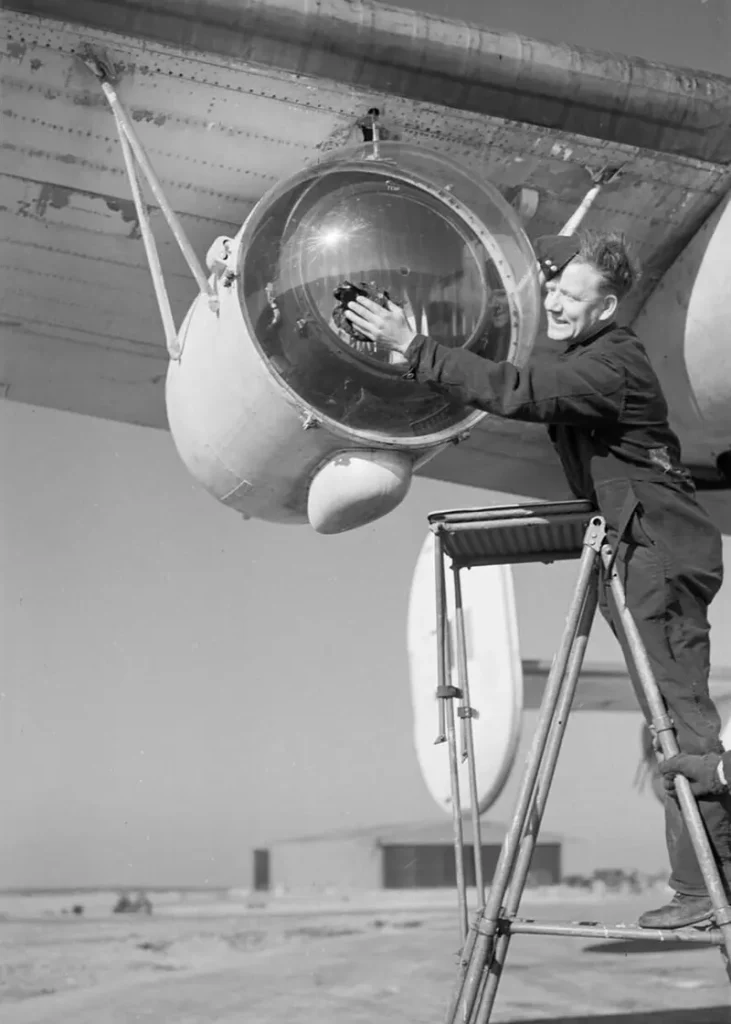
Cleaning a Leigh anti-submarine light on a B-24 Liberator. The Leigh Light was a powerful, searchlight used by the RAF Coastal Command during World War II to illuminate German U-boats on the surface at night, enabling aircraft to attack them with bombs and depth charges before the U-boats could submerge.
My return flight from Lagens airfield, on the Island of Terceira Island in the Azores, to St Eval in Cornwall was my last flight in the RAF. Our aircraft was a Leigh Light Liberator, Leigh Light was a very powerful searchlight located on the Starboard wing used to illuminate U-boats at night and named after the Inventor W/C Leigh.
Prior to take off, we had with the help of the ground staff, removed the innards of the Leigh Light and packed it with purchases from the USPX, such as stockings, cigarettes, chocolate and other items unobtainable in the UK together with fruit such as Pine Apples etc. All this was unknown to the Skipper, but we had to indicate to him before take-off that the Liberator would seem heavy on the Starboard side, which he acknowledged as soon as the wheels left the iron matted runway.
[USPX was the US Post Exchange. Post Exchange (PX) were the military-run stores, for servicemen to buy essential items like stockings and cigarettes.]
After some hours flying we were overhead St Eval, and could hear the Flight Controller Giving the Skipper landing instructions which included the fact that Customs would be there to greet us as soon as we reached our parking area. Panic set in as we were heavy in dutiable items.
First out of the airplane were the Officers who bore the brunt of the Customs Officers, and who were no doubt aware that we would not be arriving empty handed. When our turn came, we declared things we had on us like a watch and some items in a kit bag. We were treated very lightly, and I recall forking out ten shillings as duty as did so many of the others.
After Customs had left we waited a while for transport to our billets. Requested the ground crew for a Ladder and proceeded to remove the booty from the Leigh Light, which was packed neatly in kit bags The Ground crews goggled in wonder. Obviously, we had to share some of the booty with them, but not much. Cigarettes and chocolate mainly.
Then off to our huts to divide the spoils as we were due to go on leave the next afternoon. I recall sitting on the doorstep of 89 Goswell Road, London, waiting for my aunt to come down around 6am to unlock the front door and pick up the milk. She nearly passed out when she saw me sitting there hugging a nice-looking pineapple, The surprise came when I produced real silk stockings for her and her two daughters, and a long-standing friend who lived with my uncle and aunt. My Uncle was my mother’s brother and had been practicing medicine in London for some years.
This story had to be repeated on many occasions by my aunt who thought I was a hero. It was good to be able to laugh after the terrible time London went through during the War, but now that was all over, and Peace once again had come to the World.
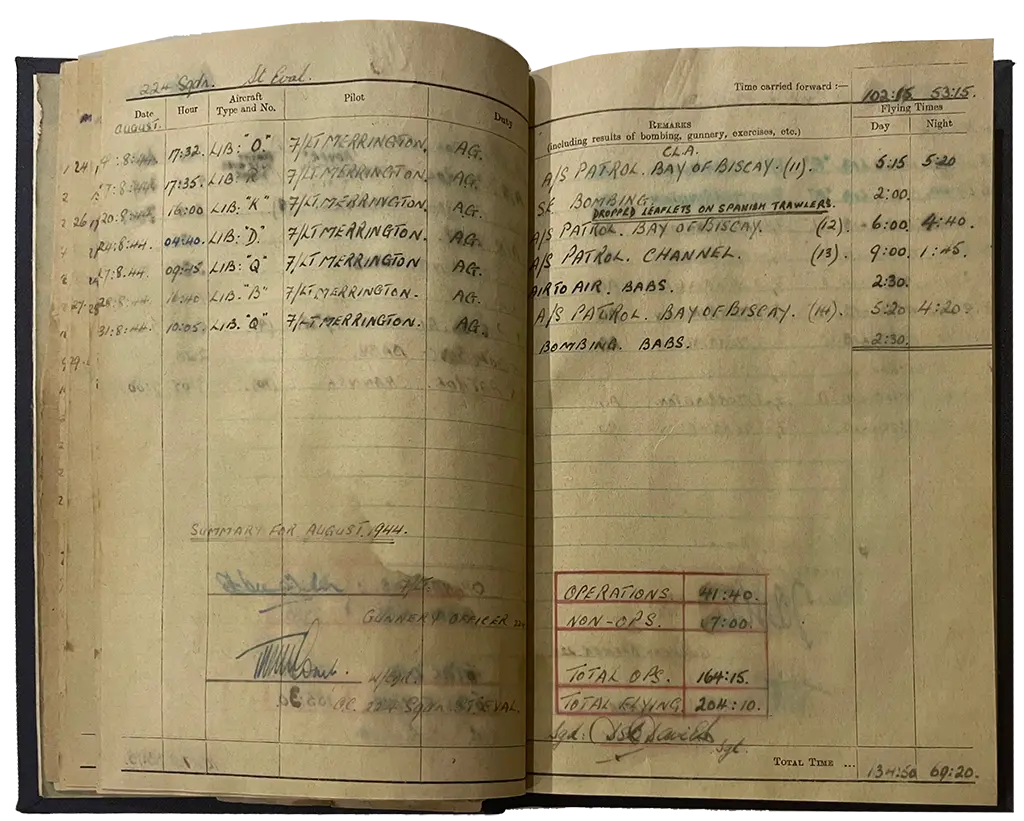
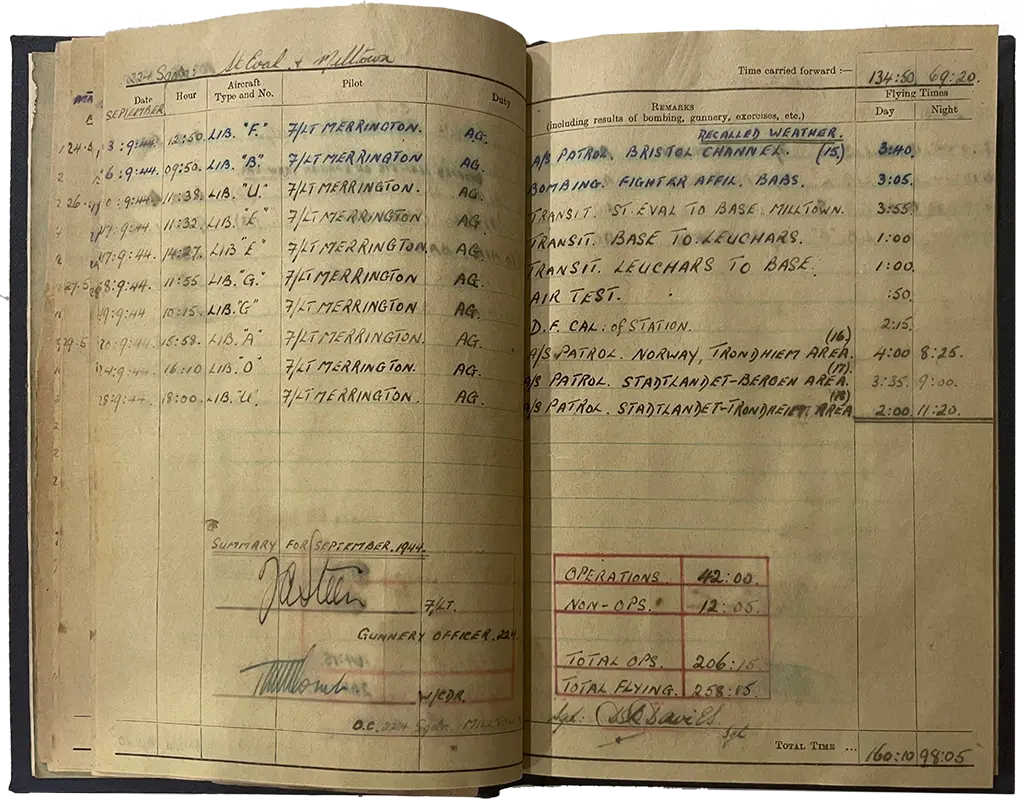
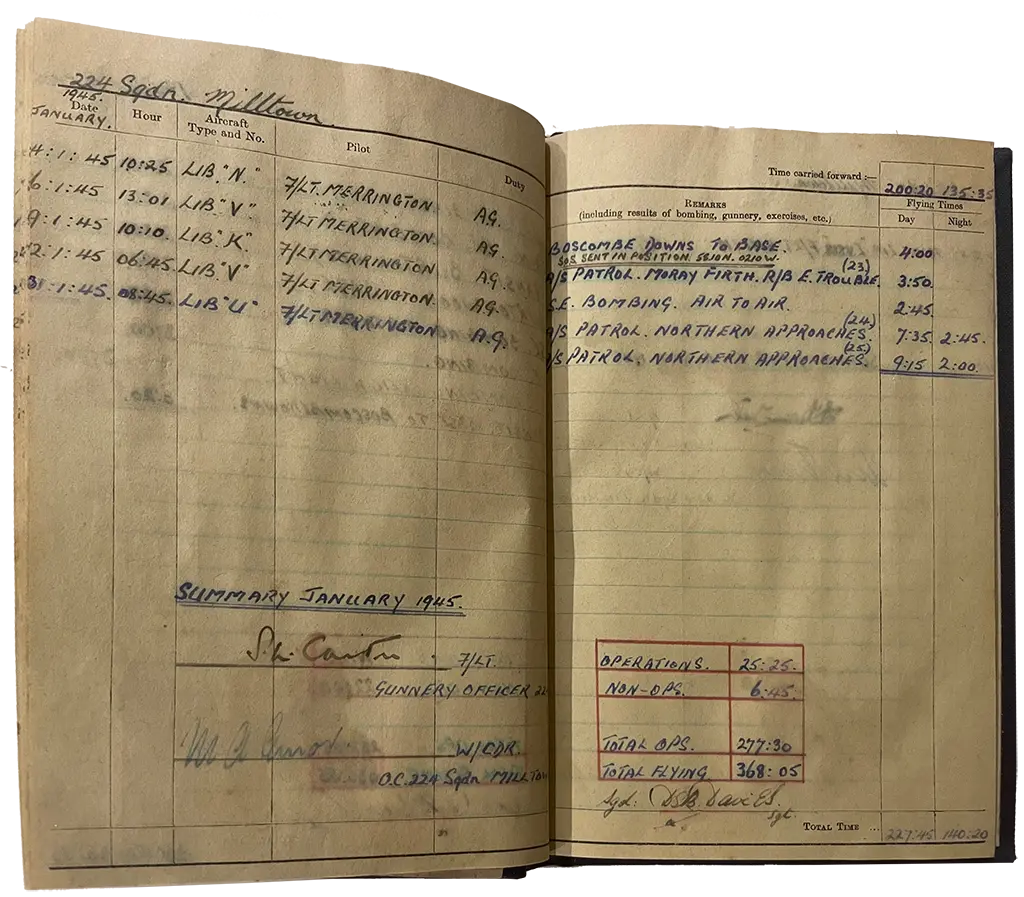
“This was the end of my flying career with the RAF. My flying logbook indicates that my wartime flying spanned the period May 1944 to June 1945in which time I completed 35 operational flights and other missions for a total of 580 hours.”
Advertisements
John Davies has provided us with a selection of pages from his Dad’s logbook. John told us Derek’s logbook is not in good shape having a long time ago survived a flood!
A selection of pages from Derek Davies’ logbook.
John Davies told us:
What stood out when looking through Dad’s logbook was how long some of those U-boat hunting flights over the Atlantic were, and how cramped, cold, and noisy the B-24 must have been on those long missions. It’s one thing to see the flying time in hours listed in neat columns of ink, but another to imagine the men who lived them – bundled in heavy gear, surrounded by the constant drone of engines, scanning the vast grey ocean below for any sign of U‑boats.
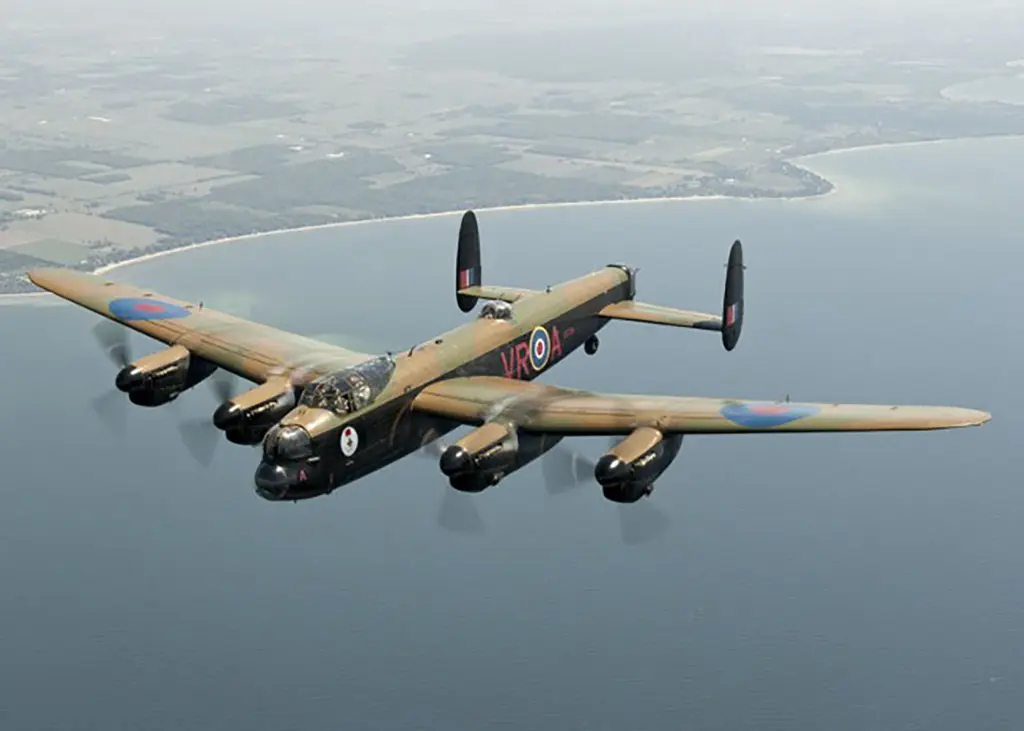
I had a small taste of what that might have been like a few years ago when I flew in one of only two airworthy Avro Lancaster bombers, operated by the Canadian Warplane Heritage Museum (CWHM) in Hamilton, Ontario. (The other is flown by the RAF’s Battle of Britain Memorial Flight.)
Even with modern ear protection, the noise inside the Lancaster was overwhelming as the four engines thundered to life. Climbing around in the Lancaster – which was actually wider and taller than the B-24 – was no easy task. The narrow passages, sharp edges, and exposed metal gave a glimpse of how unforgiving those aircraft were. The cold seeped in through the thin aluminium alloy fuselage (there was no insulation), and you could hear the wind whistling through the rivet holes.
That short flight was enough to make me appreciate what Dad and his crew endured for six, eight, sometimes ten hours at a stretch -out over the empty Atlantic, hunting U-boats, never knowing what they might find.
The B-24 Liberator and the Avro Lancaster were two of the most important Allied heavy bombers of World War II.
The American-built B-24 was faster, had a longer range, and was slightly larger overall, with a wingspan of 110 feet compared to the Lancaster’s 102 feet, though it was narrower and less tall. The B-24 was ideal for long-range missions, such as U-boat patrols. The Liberator was notoriously difficult to fly and had a more fragile structure, mainly due to it’s thin high-aspect-ratio Davis wing which was more efficient, could carry more fuel and gave better performance at lower altitudes. This advantage, however, came with trade-offs: higher wing loading meant more stress, less tolerance to damage, problems with ice forming, and more difficult handling when heavily loaded or in bad weather.
By contrast, the British Avro Lancaster was the RAF’s primary strategic bomber, renowned for its payload typically of 14000 lbs, and its role in iconic operations like the Dambusters Raid. While it had a slightly shorter range, the Lancaster was sturdier, easier to handle, and devastatingly effective in night bombing campaigns over Germany.
Davies left 224 Squadron RAF Coastal Command in November 1945.
“Jeff Wilkinson, the other Specialist Gunner and I have remained very good friends from those far off days and are constantly in touch. In fact he and his wife are presently in Barbados. In turn I visit him in Cheshire each English Summer.”
“After hostilities ended in the Far East, the troops had to be found some form of relaxation and consequently sports of all natures had to be brought into being. I was seconded to the then Colonial Office and worked with such greats as Arthur Wint, Peter Bynoe and Ulric Cross, all of whom were ex Aircrew. Our job was to assist in returning other West Indian personnel to their Homelands. I was then posted to Sutton Coldfield near Birmingham.
I continued repatriating other West Indians. One day I met F/L Sam Collens, DFC, who had come to the Station to attend Court, as one of my men was charged with Bigamy. F/L Collens, DFC hailed from Antigua and was, like me, on extended leave from the Royal Bank in Antigua. He asked if I would like to come and work with him at HQ Maintenance Command, Andover as his Assistant. I jumped at this as my fiancée was stationed in the War Room in London, which was not far away.”
“We were well suited to each other, and things were pretty easy on the Station. One day Collens said he was getting married on the coming Saturday and I was to be the Bestman. So said, so done. It turned out none of us was aware that his wife to be and mine were friends and a great time was had by all.”
Honours and awards gained by the Squadron members tell more than words the history of the years 1939-1945:
Award
Tally
Distinguished Service Orders (DSO)
5
Bar to DSO
1
Distinguished Flying Crosses (DFC)
46
Distinguished Flying Medals (DFM)
47
Conspicuous Gallantry Medals (CGM)
2
Members of the Order of the British Empire (MBE)
2
British Empire Medals (BEM)
2
Mentions in Despatches
56
“At this time, I was only a Flight Sergeant and worked under the likes of F/L Arthur Wint, of Olympic fame which was still to come, F/L Peter Bynoe and S/L Phillip Louis Ulric Cross, DFC, DSO, highly decorated, for his tour in Bomber Command. I remember that his bearing and easy manner impressed me greatly at the time. He came to Barbados many times after returning to Trinidad and used to look me up at the RBC on these occasions.”
“As a Barbadian, I was roped in to a swimming squad, preparing for the Inter Services Swimming Championships (Navy, Army, RAF). Having done fairly well in training and the trials, I was selected to swim the third leg of the relay. We won the event for the RAF in record time, and I became the proud holder of a silver medal suitably inscribed.”
“F/L Collens, unbeknown to me had put my name down to swim in the RAF Championships at St. Athans, in Wales. I did well enough there to be chosen on the RAF team to compete in the Inter Service swimming championships which were to be held at Aldershot. Again, I did creditably well and was requested to represent the British Services vs those in Belgium.”
“Prior to this, I had in fact taken part in several swimming meets in Bournemouth, while awaiting a posting to commence my training as a Specialist Air Gunner. Indeed swimming was a great form of relaxation, though I found the water in the swimming pools much colder than the sea to which I was accustomed.”
“It was at one of those meets that I met Gweneth a friend of another Airman with whom I was billeted. It was on 17th June 1946 that we were married. It was her 21st birthday.”
Derek Davies and Gweneth Davies (nee Fulker) after their marriage at St. Peter’s Church in Staines on 17th June 1946.
Our bestman was none other than Jeffrey Wilkinson, as the bond of friendship which existed in our flying days still continued in peace time and will, until the inevitable takes place.
“The British Services swimming meeting in Belgium was to be held in a months’ time. Unfortunately, the date coincided with my repatriation to Barbados. I had to decline as I was not going to miss returning to Barbados after being away from home for some four and a half years and lucky to be alive!”
“I arrived back in Barbados in the Harrison ship SS Advisor, whose coal bunkers had been taken out to make room for bunks Starboard side was for men and the Portside for Ladies. They were several ladies among us, including my wife of six months.”
Advertisements
Prior to returning to Barbados Derek Davies was promoted from Flight Sergeant to Warrant Officer. Davies returned to Barbados on 24th December 1946 and was not officially discharged from the RAF until 10th April 1947. He re-joined the Royal Bank of Canada shortly thereafter.
Derek Davies has two children, John now 55 years, who is a Senior Vice President with Toronto Dominion Bank in Canada and Elizabeth, who is a Paralegal Secretary with a firm in Bay Street in Toronto. His wife Gweneth Eileen died in 1980.
[Based on John’s age – this suggest the interview between Derek Davies and Paul Foster took place in 2005. It was published in July 2006, we think in the Advocate. Paul Foster died in December 2016.]
Davies recalled one final note about the war that took place many years ago. “While travelling on a Geest Line Banana Boat her Captain, who was German, remarked to me, ‘I understand you were looking for me during the war’. I have no idea who told him, but my reply simply was “Yes and as you are here, we did not find you.” “We both laughed, and we became good friends on the voyage and had many a drink together.”
John Davies provided a little insight into this incident:
We were travelling from Barbados to the UK on a Geest Line banana boat. Our family, including my sister and I, were invited to dinner with the captain.
The Captain never said whether he’d served on a U-boat, but something in the way he spoke, and the fact that he was about Dad’s age, made it seem entirely possible.
I looked out the porthole and saw a dolphin jumping as well as an island which was part of the Azores.
My Dad then piped up “this is where I used to train during the war”.
With a straight face the Captain said “Ah you must have been looking for me”. I almost fell off my chair.
After dinner Dad and the Captain disappeared and we did not see Dad again until the morning when he was the worst for wear.
John Davies
“I have been a member of the Barbados Legion and the Barbados Military Cemetery Association, for many years now and have been the Treasurer of each for over ten years and still am at the present time. Consequently, I am in charge of all their funds. For the former I am required to make up the Welfare payroll each month, which consists of some 53 names. Part of the payroll is mailed out at the recipients request and the others paid directly to the Legionnaire.”
“I also assist the Garrison Secretary daily with the routine of her office and am therefore in constant contact with members of the Legion. This gives me great pleasure in meeting the Legionnaires and chatting with them and in the end seeing that those who wish to be laid to rest in the Military Cemetery receive the honour that they so richly deserve.”
They shall not grow old
As we that are left grow old
Age shall not weary them
nor the years condemn
At the going down of the sun
And in the morning
We will remember them.
Derek retired as Treasurer of The Barbados Military Cemetery Association in March 2006 and retired as Treasurer of The Barbados Legion in September 2006.
John Davies provided one additional insight into the Merrington crew of 224 Squadron and their Doomie badges. The Davies family still have their Dad’s Doomie which he wore for all the years he flew after his time in 224 Squadron.
Doomies
Derek Davies’ Doomie badge – made for him and his crew by the mother of his friend, Jeff Wilkinson, the other Specialist Air Gunner.
During 1939-1945 several names were coupled with Doomies, Gremlins, and P/O Prune.
Doomies were the little men who were kind and helpful and were opposite to Gremlins who were very unkind and not at all helpful and the most obnoxious little creatures.
P/O Prune was a newly promoted Pilot who could not but help do something wrong. Nevertheless other Pilots learnt from his mistakes and became most proficient.
The story related here is true and I [Derek Davies] have no doubt at all that my Doomie and the those worn by members of my crew saw us safely home that day and defeated the Gremlins. Thorough checks of the Engine disclosed nothing wrong, and this aircraft was flown by us several times subsequently, without further mishap.
This is a story of Doomies and Gremelins. The former are nice guys with long noses and the latter are bad guys who get up to all sorts of horrible tricks at times.
In 1944 while stationed at Milltown on the East side of the Moray Firth, our Skipper F/L Merrington and his crew were briefed on a U-boat hunt off the north of Scotland. It was a cold and wintery day and one would have sooner been in the Mess before a nice fire, than flying in the cold or that’s how the two Gunners felt, as soon they would experience the biting cold air alone in their unheated turrets.
Our Liberator had previously been serviced and pre-flight tested according to regulations and was waiting for us on its hardstand. The usual forms were signed by the Skipper indicating that he was satisfied with the aircraft. in we went through the bomb-bay and each member of crew took up his position to check the equipment. As was the usual practice the engines were run up and checked.
By all accounts everything was as it should be and the Skipper announced “Take up positions for take off”. All crew with the exception of the two Gunners remained on the flight deck. These two crew had the honour of sitting in the Beam gun positions. Our Job was to inform the Skipper after being airborne that the wheels were up and in position, reel out the radio aerial, open the air deflectors, open the beam windows (it took two to do the last two.) Last of all mount the two .05s to be maned by two off duty wireless operators.
Jeff then went to the rear turret and I to the front. I had no sooner started to enter when the aircraft gave an unfamiliar lurched to starboard and the skipper came on the intercom “Wireless operator SOS immediately”. Our starboard wing was down, the outer starboard propeller was just windmilling and the sea was coming up to meet us at a rate of knots.
It was then I remembered my Doomie pinned to the collar of my Battle Dress and said a silent prayer.
When about 200 feet from the sea the engine spluttered and resumed its natural purr. The Skipper informed the Wireless Operator to cancel the SOS and inform base we were aborting the operation due to engine trouble.
We landed perfectly and dozens of Mechanics boarded when we came to a stop, but try as they might the engine would not repeat its earlier performance.
The Skipper merely said enough excitement for one day, let us return and be debriefed and have a drink.
These Doomies were made by Jeff Wilkinson’s mother who had said each of us must have a good luck piece. How right she was. Bless her.
Written by Derek Davies
Thanks
Our thanks to Mary Gleadall who shared a transcript of the Derek Davies interview with Paul Foster from 2006.
Our thanks to Derek’ s children John and Elizabeth who live in Canada. They have given us permission to re-print this interview, made some corrections to the original copy and shared some photographs of their father’s time in 224 Squadron including some of his logbook entries and provided some additional memories.
Postscript
Gweneth Eileen Davies, Derek’s wife died in Barbados on 12th May 1980.
Derek Sewell Blackburn Davies died in Barbados on 22nd September 2011.
Gwen and Derek are both buried in the Barbados Military Cemetery. Gwen was in the WAAF and worked in the War Rooms in London during the WWII.
Norman Bradley Merrington who was Derek’s pilot in 224 Squadron died in an air crash during the Berlin airlift. On 5th April 1948 while on final approach into RAF Gatow in Berlin, his aircraft, a civilian British European Airways, Vickers Viking 1B, G-AIVP was buzzed by a Soviet Yak-3 fighter aircraft which clipped his wing causing both aircraft to crash. This cold war incident is known as the Gatow Air Disaster. There were no survivors of either aircraft.
Advertisements
Background Information on RAF Coastal Command 224 Squadron
Caribbean Aircrew that served in the RAF during WWII
Caribbean aircrew in the RAF during WW2 – A record of West Indian volunteers who served in the Royal Air Force during the Second World War, is a great source of background information.
Additional Context
Within this post we have used [square brackets to provide additional context] to some details.
3 responses to “W/O Derek Davies – A Bajan Specialist Gunner with 224 Squadron RAF Coastal Command”
Douglas Newsam
I enjoyed this account of the experiences of Derek Davies in Squadron 224. I met Derek in the course of my job as an auditor, he was a Director of one of our clients.
His son John worked with me at the same audit firm.
I never realised that Derek had served in the RAF and had seen active service.
Thanks for sharing this and to John for allowing it to be shared.
Help Us Share More Bajan Stories – Make a Donation:
BajanThings is a passion project dedicated to preserving and sharing Bajan culture, stories, and history.
Your support helps cover the annual costs of running the BajanThings website and fuels our mission to document and share Bajan stories for future generations.
If you would like to be kept informed when there are updates to BajanThings please subscribe to our e-mail update notification. Whenever there is new content added to BajanThings, you will receive an e-mail telling you of the update:
Lord Nelson’s statue – Bridgetown, Barbados has been updated following its removal on 16th November 2020 with details of the public subscribers and details about the forged Nelson-Taylor letter.
Craig Burleigh is an American born, Bajan bred, San Francisco Bay Area based professional photographer. In Barbados Island Life Craig has pulled together his back-catalogue of photographs of Barbados from the 1970s together with the stories behind those photographs. Check out Barbados Island Life.
To get an e-mail update when a new post is added to BajanThings add your e-mail address below and click on the SUBSCRIBE button. Your e-mail address will automatically be added to the BajanThings subscriber list. Whenever there is new content added to BajanThings you will receive an e-mail telling you of the update.