The things that stand out in my mind about the Barbados Rally Scene in the 1960’s and 70’s were the enthusiasm and sense of fun that was there among the contestants and the dedication of the marshals. I was often amazed that we would go around a corner in somewhere desolate like Archers in St lucy and find a solitary person with a D Check sign at 4am in the morning. Or, passing Paul Pilgrim with his rally car stopped sitting under a tree with a cooler by his legs, the fun being more important than winning. Another thing was that the rallying was mostly done in everyday cars which the contestants would drive to work the day after the rally, only modified to add a sump guard sometimes and, later on, with the addition of timing and distance measuring instruments.
In my rallying career we were in different cars in every rally we entered, even one borrowed from Richard’s dad. That Richard Cumins and I clicked as a rally team is just one of those things that happen by chance. Richard was hopeless at any navigating and relied on me completely to tell him where to go, which he did without question. He was the most consistently good driver that I was fortunate to have. And he had a quick mind for mental calculations which he used to keep us on time. In all our rallying, we used one of Richard’s many cars and shared in the cost of the equipment. Richard was well known for changing his cars regularly.
My rallying career started by chance. Peter Ullyett and Andrew Phillips had entered a Mobile economy run. To do so they were required to provide the name of a person who would act as an observer in another contestant’s car. The observer was to make sure that the contestants adhered to road rules, such as stopping at major roads and to have the drive engaged so that the car was not slipped out of gear to coast. I volunteered for them and was assigned to be the observer for Jimmy Croney and Jimmy Niblock. There was a deluge of rain during the event which even saw Willie Hassel and Mack King sliding off the road over a bridge at Greenland.
During the event I found a map and spare route instructions on the back seat where I was sitting and on picking these up, I found that I could easily follow the route instructions on the map.
Having found out that I could navigate a bit, I jumped at the chance to go as the navigator for Richard Cummins when he was trying to find a navigator to go with him on a Lucas Night Rally. He borrowed Andrew Phillps’ Ford Cortina GT and we set off and were doing quite well on route when the car’s alternator stopped working and we were forced to retire. But the scene had been set and we agreed to go together in the upcoming June Rally, which was set by Trevor Gale, The Chairman, as he was called. This was to be the first 500 mile June Rally .
For the June Rally, Richard managed to borrow an old, creaky Volkswagen from City Garage. This had been used by Colin Coles who worked there, and he had taken out the 1200 cc engine and replaced it with a bigger engine that had come from a Volkswagen van, however this did little to make it go faster.
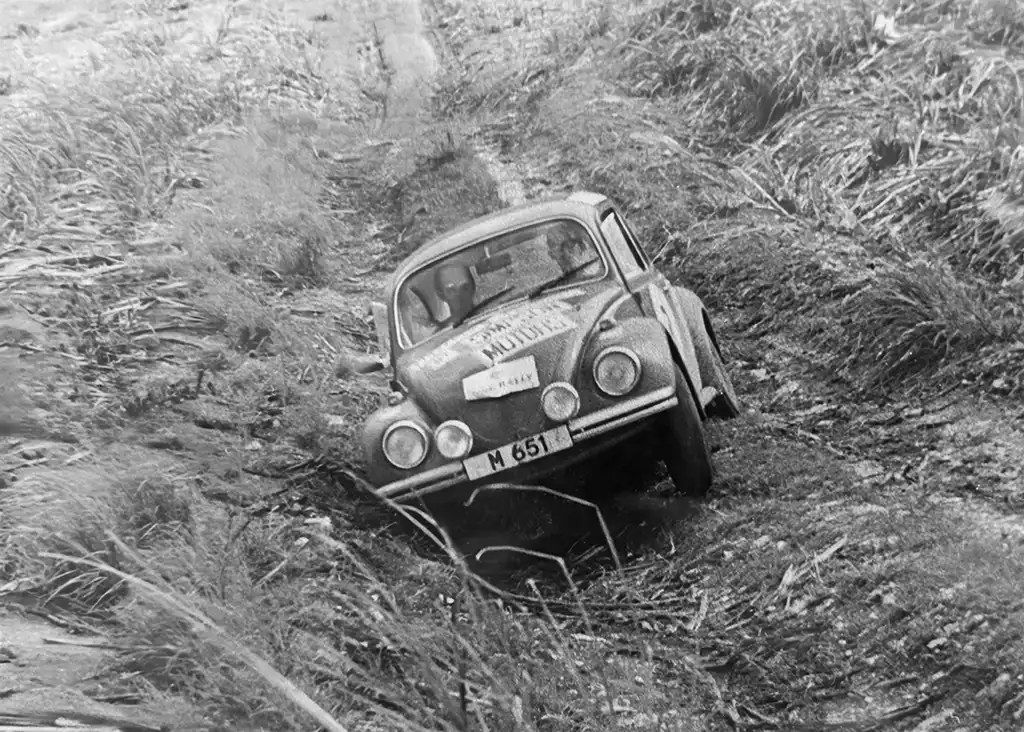
We set to work to get the car ready by adding two spotlights which we wired ourselves a map reading light inside. The car odometer could only read in whole miles with no tenths of a mile. The rally was to start before noon on a Saturday, and to run all night to end about 5pm on Sunday. We were drawn car number one and were very excited. Richard found a big plastic poster of a tiger which he fixed to the front of the car, thereby supporting the sponsor Esso whose motto was “Put a Tiger in your Tank”.
That we had drawn car number one was quite daunting for first timers. We set off in fine style except the tiger blew off the car very soon after we started. The only means for us to keep on time was to use Richard’s watch as the timepiece and for me to calculate the miles per minute required by the average speed set, and for Richard to calculate in his head the distance we should have travelled from the starting point using the odometer to give the distance. The problem with this was that when we checked at a particular distance, by the time we had done the calculation, another whole mile had registered on the odometer, and we were therefore late at that point.
Fortunately, the average speeds were low, and we were able to keep up and because I was finding our way, following the route quite easily. There were one or two scary moments when Richard put the car on two wheels going around an unexpectedly sharp corner near Peter The Less chapel and unsettling moments when we went through a dip in the road and the contents of a box that was on the back seat shot up to the roof and back down over us, raining tools, spark plugs and oily cloths.
There were bits which were comical such as when Mack King, who was navigating for Willie Hassel, got out onto the running board of the Volkswagen they were driving behind us, and started to shoot at monkeys in Bakers Wood and when we turned on the spotlights at night and the generator light came on showing that we were discharging the battery because of our inexperienced wiring job. No alternator for the old VW.
There was an incident that may have helped change the way rallies were run in the future. There was a system of closed, locked boxes which were placed along the route and contestants were given a batch of tickets with the car competition number which you put into the box to signify that you had followed the route correctly.
On this rally route there was a very steep sandy hill which runs from Cattlewash through a shallow gully and up to the ridge above Cattlewash next to Springfield Plantation. When we arrived there was a car stuck trying to get up the steep hill, there was someone trying to tow it. I told Richard that to avoid losing time waiting for the track to clear, we should go around this mess by continuing up the hill leading from Cattlewash towards Joes Rive and then turn right up the hill to the ridge and to Springfield Plantation thereby saving time.
The one drawback was that there may have been a box on the sandy hill, and we would miss it and be penailsed by penalty points. So, when we got to the spot where the sandy track joined the main road near Springfield Plantation, I told Richard to stop, and I ran down the track in case there was a box. And so true, there was a box at the top of the sandy hill. So, I dropped our ticket in, ran back to the car and off we went. So when the boxes were checked, our ticket showed that we had followed the correct route, but in reality we had circumvented the hill.
When he found out about this, the club Chairman and rally setter, Trevor Gale, was furious and from that point, the box system was scrapped and instead there was a system of manned directional checks. Therefore, you could say that we helped change how rallies were run from that day. When Richard and I visited Trevor Gale many years later and he was confined to a wheelchair, he still remembered the incident and was very cross that we had beaten the system that day.
We came second in the rally because Bill Mallalieu and John Sealy, driving an Alpha Romeo Sprint got many more bonus points in the timed hill climb at Spa whereas we, in the poor lumbering Volkswagen, got none. We also found out that Bill and John had used a Halda Speedpilot. This has a mechanical clock with an extra hand that you line up with the minute hand when you start. You calculate the average speed for the leg and set that on the other dial. If you stay exactly on time the extra hand stays exactly under the minute hand. This was a huge advantage over my calculations, Richard’s watch and the odometer reading in whole miles. We were determined to get one for our next rally.
In the next night rally I went with Karl Johnson in a mini Cooper S and placed third. Karl was an Expat and was a very precise person. He told me at the start of the rally that he would respond “check” to any instruction to turn left or right so that he didn’t say “right” to a left turn instruction.
At June Rally time and Richard Cummins and I were preparing ourselves and our car. I was very serious about doing well and improving our placing to first, and I had heard that a supplement called Sanatogen Nerve Tonic improved concentration and decided to give it a go. So, two weeks before the rally I took this powder dissolved in water. It tasted awful but, on that basis, I thought it must be good.
I got some for Richard and he agreed to take it as well, but I believe that he used to cheat. Similarly, I had stopped drinking alcohol and worked on Richard to do the same, but I believe that he also found this difficult to do. I had bought a map magnifying tool that was lighted and had a cup over the lens so that it could slide over the surface of the map. I used to sit with the map and go over every inch of it, looking for partially hidden tracks and features and finding previously unknown roads.
For the car we were to use, Richard had borrowed his father’s Holden Special car, which was large, automatic and comfortable. We were laughed at for using an automatic car, but we thought that as there was to be only one special stage on dirt roads, that comfort was more useful than speed. Also, the Holden was built in Australia and was very rugged.
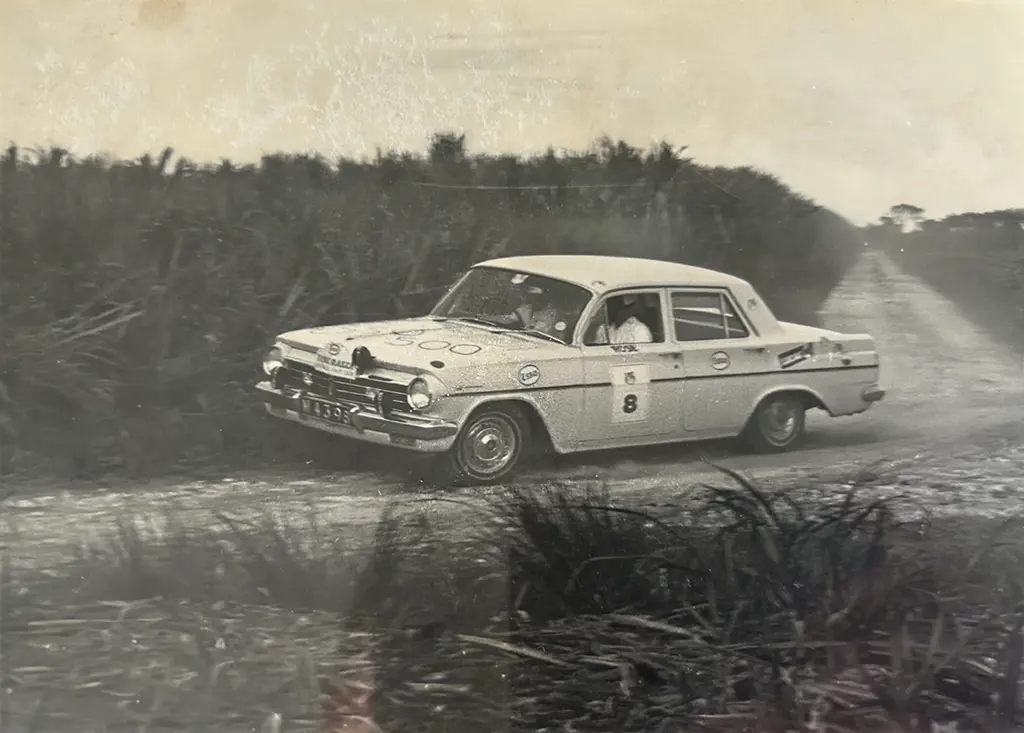
We bought a Halda Speedpilot not to be outdone by Bill Mallalieu and others, which we installed on a bracket at eye level on the dashboard and spent time carefully calibrating the distance registered and the accuracy of the clock. This careful preparation paid off because we won the rally quite easily. There were some very nice prizes including a silver tray with six crystal champagne glasses and a wrought iron patio set to go along with the usual challenge cups for overall winners and winning navigator.
A big surprise was that Emtage Electric, the agents for Holden, gave us a week-long trip to Trinidad to see the factory there which was to make Holden cars. This was a hectic trip, because apart from seeing the factory, we drove to south Trinidad to see the pitch lake and to see a girl that Richard said he knew but she wasn’t there.
Richard hated flying and to settle his nerves we had several drinks before boarding the plane for the return, and this must have affected us badly because on returning to Barbados, we lost our passports. I had to apply for a new one quickly to be able to go to Jamaica for the November rally and we only discovered where the passports went some years later when an immigration official phoned to say our passports had been in an immigration desk drawer at the airport from the time we returned.
For the June Rally next year Richard had a Mini Countryman station wagon which had some minor improvements to performance and the main preparation of the car was to fit a sump guard because the Mini sump was so low to the road. We were told to expect Tulip diagram along with the usual BRC route instructions and so we bought a Halda Twin master which recorded mileage accurately on two windows each of which could be cleared by pulling a lever.
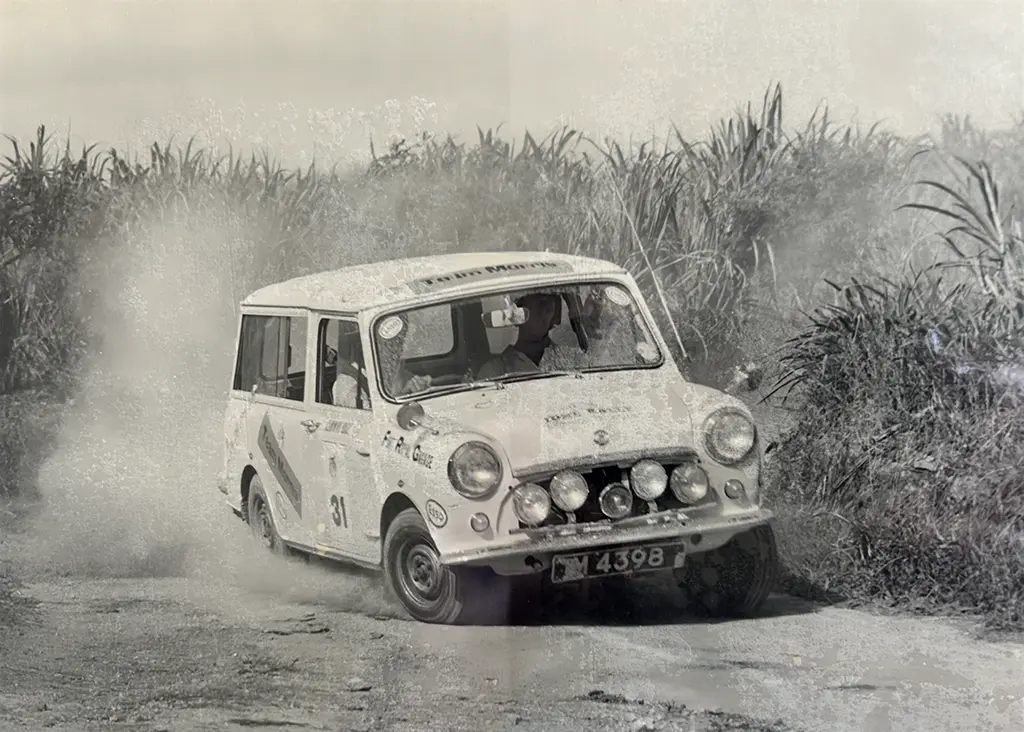
I did my usual preparation including the Sanatogen routine and we did some practice runs to check on tracks that could be possibly used. In the rally we did not get off to a very good start and were not among the early leaders and we ran into some bushes in one of the special stages causing us to get penalty points. But we persevered and slowly got better. On Sunday, coming into the lunch stop we had a tyre puncture and Richard chose to run the car onto its sump guard on the remains of a very low soft stone wall in Carrington factory yard so that we could change the tyre without using a jack.
Then we were off for the anticipated Tulip diagram stage which was to take us to the end of the rally. By the time we reached St Lucy on the route we heard on the radio that we were back into first place. Then disaster struck. The car engine cut out and we frantically tried to find out what had happened to discover that the sump guard had been pushed up when the car was run onto the low wall and had rubbed the insulation off the battery cable, shorting the battery. We thought that we were finished when along came Tommy Bentley and John Skinner who stopped, took out their battery with the engine running and gave it to us. We did the battery swap, pulled the sump guard off the battery cable and got the car running again.
We then followed Tommy and John for a while until I found my place on the route sheet, and we overtook them and went on our way. Because they had not turned the engine off when they took out the battery, they were able to keep running. If their engine had stopped for any reason, they would have been out of the rally. Their unselfish and generous act was an example of the sportsmanship that was a feature of the rallying in those days, and I have never forgotten it.
We had lost a significant amount of time during the crisis and Richard drove like the wind to try to make up the time lost, and we were unsure of the correct distance travelled so our timing was guess work, but we managed to finish third which was a good achievement in the circumstances.
In the next June Rally Richard used a Singer Vogue which was his vehicle at the time. We fitted a sump guard and the Halda instruments and before the rally Richard and I were out checking on some dubious tracks near to Cleland Plantation when we became well and truly stuck and I had to run to the plantation house and ask Keith Weekes who lived there to pull us out which he did with a four-wheel drive Bedford truck.

The incident must have helped Richard understand the car better because during the rally the route took us from Cattlewash near Round Rock through a shallow gully and then up a track on the ridge of gully to Springfield Plantation several hundred feet higher than the Cattlewash road. This was the same hill we had circumnavigated in 1967. When we arrived at the point, there were several cars trying to get up the ridge, but Richard managed to pass them and we went up the track with a lot of difficulty, slipping and sliding to keep going so we didn’t stall.
Doing this gave us a big advantage, by following the correct route and saving on time lost which we were able to make up. This was a big factor for us in winning the rally. We incurred only 84 penalty points for the entire rally, made up of 280 penalties from the road sections, which were reduced by gaining 196 of 240 available bonus points in the special stages. We had the least number of road section penalty points and the highest number of bonus points of any competitor. This remains the record for the lowest number of penalty points ever achieved in a 500 mile rally in Barbados.
Next year the June Rally was set to be over 600 miles and there was tremendous interest. Richard had a Datsun 1600 SSS which would be ideally suited as we were told that there were going to be several special stages including one that was over 10 miles long on cart roads. I persuaded the Burroughs office equipment company to loan us an electronic calculator which was powered from the car. This was about the size of a thick paperback book, not the little things we have today and fitted this into the cubby hole with the cover removed.
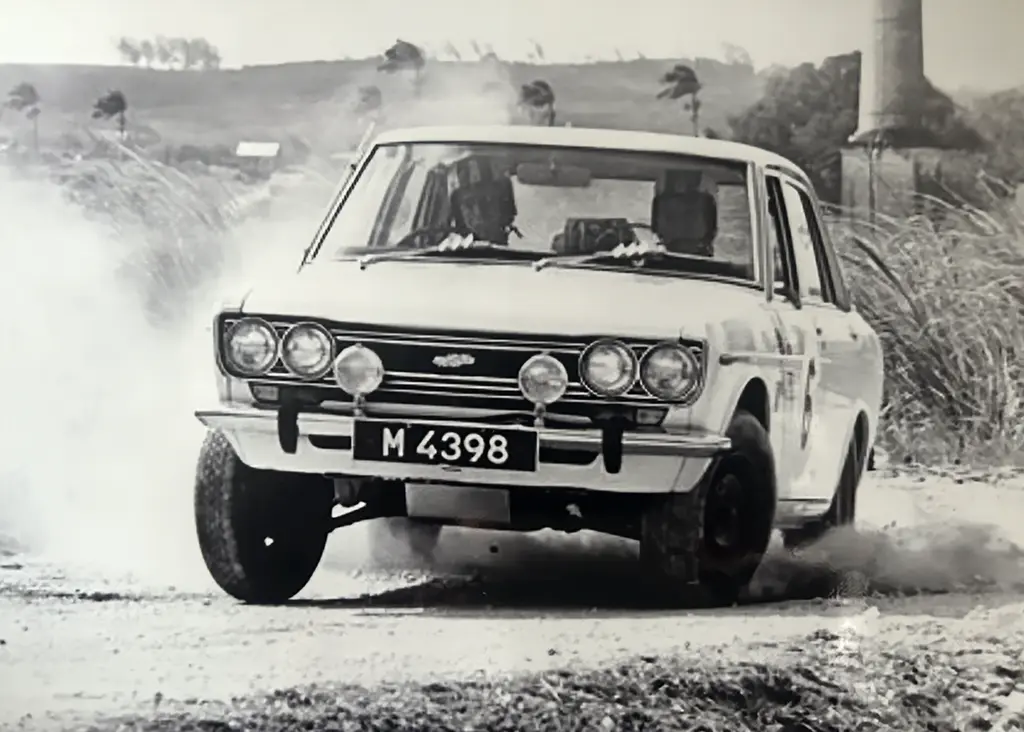
We prepared in the usual way but at the last-minute Richard decided to change the tyres to a type more designed for off-road use in anticipation of the 10 mile stage. This required a last-minute recalibration of the Halda instruments, but we managed to do this and were ready to go. We drew number 78 which was the last car in the rally. There was a huge crowd at the National Stadium where the rally started as interest in motor sport by the public was at an all-time high.
On the Saturday of the rally, we came to the 10 mile stage which was to run from Four Square to Lower Greys all on cart roads. Being the last car in the rally, Bizzy Williams , the starter, held us back an extra minute so that the cars in front would be clear. But soon after we set off, we came up behind a car driven and navigated by the Branker brothers that was travelling very slowly. We tried our best to pass, blowing our horn and going right up almost touching their back bumper, to no avail, they just would not let us pass. We had to motor along behind them through most of the stage.
There were angry words exchanged at the end, but the fact was that we had incurred a significant penalty whereas we were expecting bonus points. During the night stage we did our best ever stage and incurred no penalties for the entire stage. In the morning, we were leading but, in the afternoon, we came to a special stage on a paved road from Bawden to Turners Hall.
It had rained very slightly when we set off only to be confronted by a bus coming in the opposite direction on what was a closed road. We had to pull off the road and stop to let it go by and this annoyed Richard who set off up the hill going as fast as he could. Usually, the club hill sprints started on the up slope at the bottom of the hill but this time we had a running start, so when we reached the top of the first hill into a sharp left hand turn, the car understeered off the road into a ditch. The combination of the wet road with the off-road tyres and overdoing it after the bus incident contributed to the incident. We reversed out of the ditch and Richard drove gingerly to the end of the stage. Again, we incurred penalties and found that the right front suspension and fender were damaged. However, with help, we pulled the fender off the tyre and decided to go on our way. Later in the afternoon we were doing a bit of straight-line navigation when I missed a blur on the map which was considered a road by Trevor Gale, the route setter, and as a result got a wrong direction at a directional check. At the finish we found that with all of that, we had been beaten into second place by less than 50 penalty points. We protested vigorously about the balking that we had on the 10-mile stage but were told that any penalty would apply to the persons doing the balking and we had no recourse. We protested that we were unfairly impeded by the bus on the Turners Hall stage but this was also rejected and so we were left dejected.
We missed the next June Rally as we were still smarting from our so narrow loss the previous year and the circumstances of the loss but the year following Richard and I entered again this time in a Volkswagen. We did not put much effort into practicing or preparing. Richard had just built a Guyanese wooden house next door to his father’s house and had been busy with that, so he did not pay his usual attention to the rally and neither did I. We still managed to place fourth.
Apart from The June Rallies, I entered a Mobil Economy Run as a navigator with David Barnard in a Singer Vogue. One incident which occurred was that we were rounding a left-hand bend at Carlton, St James when David fell asleep, and we dived into a banana patch. David tried to reverse to no avail when our observer, Gabby Edghill said leave it to me and he jumped out of the car. Gabby is a large, powerful man and with one great heave, we were out of the patch and on our way. Later, David was sleepy again and so I took over the driving for a while and allowed him to rest a bit.
In another Economy Run with Richard Cummins in a Toyota we finished 1st in Class 4 and 3rd overall. In these mileage rallies you are not allowed to free in neutral or with the clutch disengaged and that is why there is an observer to make sure that you don’t do this, among other road infringements. But you can leave the car in gear and run down any hill that you want to. We were coming down the long, high hill from Farley Hill to Greenland and Richard was letting the car run in gear but no brakes. As we were near the bottom and the speedometer was registering 70 mph, we saw a directional box. They were still using the box and ticket system that had been dropped from rallies. If we had braked to stop, we would have lost all of the momentum gained so I told Richard to let the car run until it stopped, and I would run back and put in the ticket. This I did, but it was a much longer run than I had expected, and I had to be quick so that we didn’t lose time. I believe that this exercise helped us to win the class.
Richard and I rallied together in a Toyota Starlet a Peugeot 205 GT and an MG B GT. In the Starlet we came to the top of a very steep muddy hill, and it was very wet. I remember debating whether we should go down and Richard saying we would and the car sliding completely out of control down the hill and uncannily twisting to the left at the bottom so that we were pointed in the right direction, quite scary. This hill caused a lot of trouble in the rally. In the Peugeot we were doing reasonably to the breakfast stop at Heywood’s Hotel when we tried to start the car after the break and it was dead, no response at all. We tried the battery, and this was ok and we were puzzled until a young boy passing by said to disconnect the car computer and reconnect. This we did and miraculously off we went. But later on, the car cut out again and this time the computer trick did not work and we were out of the rally.

In between June rallies I participated in a night rally with Andrew Phillips and a mixed couples rally with Wynona Phillips who drove. Greg, my son, went with me as a navigator in a father and son rally but didn’t fare too well as he got car sick. He wasn’t helped by the car, an Audi 1600, having cooling problems and we had to stop on several occasions at standpipes to put water in the radiator. After a while we had to drop out, so we didn’t damage the engine.
Interest in Rallying had waned by the time I navigated for Basil Watkins in the 1976 June rally so that there was never again the size of entry that we had in 1971 and no 500 mile rallies were run again until 1981. Basil and I won the rally with him diving a Datsun 1200.
In 1981 after a long layoff, I was persuaded to navigate in the well sponsored and highly anticipated 25th anniversary June Rally. The plan was to bring the Rothmans International team for the rally, but these plans fell through and only exiled Jamaican Colin Whittingham in a highly modified, and prepared to international rally standards, Mazda RX3 came.
This was such a rushed arrangement that Colin and his supporting friend did not have anywhere to stay and so they stayed at our home. The rotary engine in the car was very delicate and had to be used within a limited rev range and only when the oil temperature was correct. The interior was spartan and the racing seats had full harness seat belts which I found restrictive when I needed to lean towards the map to see small features.

The car shook and the engine noise was terrific and thus it was not an ideal car for a Barbadian rally. Because the international rallyists were expected, there were far more special stages on the route which suited our car and so we were doing very well in first place up to the dinner stop.
I found it very difficult to see the vibrating map and the engine noise made concentration difficult, so we fell away from the top places during the night. Somehow, we managed to get to the breakfast stop at Sam Lords Castle at 4 am and were ready, being car number 1 again, to go on a special stage on closed public roads from the castle to Stewarts Hill going through St Catherine’s and Wiltshire.
We were roaring along and came to what looked like an innocuous left-hand bend only to find that it tightened significantly once in the bend. The car shot across the road through a ditch and onto an embankment on its right side. The front suspension was damaged and so the rally ended for us.
The next year Richard and I entered again in his Volkswagen Gol, a car made in Brazil and was left hand drive. We drew number 1 position again while Roger Manning and David Edwards drew no.2. They had won the previous year and so we both kept a close eye on each other. We were not getting many penalties and neither were they when we came to a track in St John which had been used many times and although it was shown on the map as going straight and over an escarpment, the route used many times avoided the escarpment and turned to the right and then around the rock outcrop and down a more gentle slope to join where the track on the map turned right and then left. It was dark when we got there and for once we were out of sight of Manning and Edwards.

Bill Mallilieu, who set the route, had warned us at the briefing meeting that on several occasions the route would not take traditional directions, and something told me that this was one of them. I told Richard to turn off the lights so that the others would not see where we were going, and we crept forward where the map indicated we should go and peeped over the escarpment. Then I saw movement at the bottom and told Richard, who was a bit dubious, go on and quickly. We rushed down the escarpment, turned right and found a D check waiting. We got right direction and no penalties, but Manning and Edwards had not seen us go over the ridge and used the traditional route and so got wrong direction penalties. The 50 penalties that they got made them 53 penalties more than us overall and so that maneuver had won us the rally for us.
After this we did not rally consistently and found that in an effort to be different, some of the route setters’ interpretation of road junctions was imaginary to say the least. After a while, Richard stopped entirely, and my neighbor Ronnie Alleyne persuaded me to go with him in his Toyota Starlet. These were now the days of minicomputers put out by Toyota Racing Developments, and I found them more a hindrance than a help although Ronne loved them.
I did a June rally with Ronnie and somehow came 5th. The pure form of Tulip instructions was changed, and I found the new system needed more interpretation than fact. Also, with my eyesight, which was always sensitive to changes of light intensity, I was having great difficulty in seeing clearly at night making it difficult to rally at night. I gave up rallying as a contestant at this point.
I set a June Rally route only assisted by Leslie Alleyne, Ronnie’s son, and this was quite successful. There was one glaring error in the route instructions where in changing from the Tulip instruction to the BRC system I did not put a vital turn right instruction. This caused many contestants to be late as they spent time working out the error. Otherwise, it was good rally, and I introduced a system to Barbados where the route had to be found by drawing the given map references on a large-scale map. This was never tried again even though it was successful in this rally.
Cars that I rallied in with Richard Cummins, all of which were cars that were driven to work before and afterwards:
- Volkswagen 1200
- Holden Special
- Mini Countryman
- Singer Vogue
- Datsun 1600 SSS
- Volkswagen 1300
- Toyota Starlet
- Peugeot 205 GT
- Volkswagen Gol (not Golf!)
- MG B GT
Further reading:
Craig Burleigh’s website Barbados Island Life website has a feature on some of the Barbados rally and motor sport pioneers from the 1960s such as the wild guys from the Rockley area – Andrew ‘Tenderfoot’ Philips, Harry and Basil Watkins, Richard Rose, Michael Atwell and so many others – driving fast was the order of the day! See: Early Motor Sport Island.
You may also be interested in Mike Spence’s post on the Strathclyde boys, GIN Club in the 1970s.
Additional information on the early days of Rallying in Barbados can be found on the Barbados Rally Club website.
Also see the Motor Sport Caribbean History – Facebook Group which has additional photographs and comments.