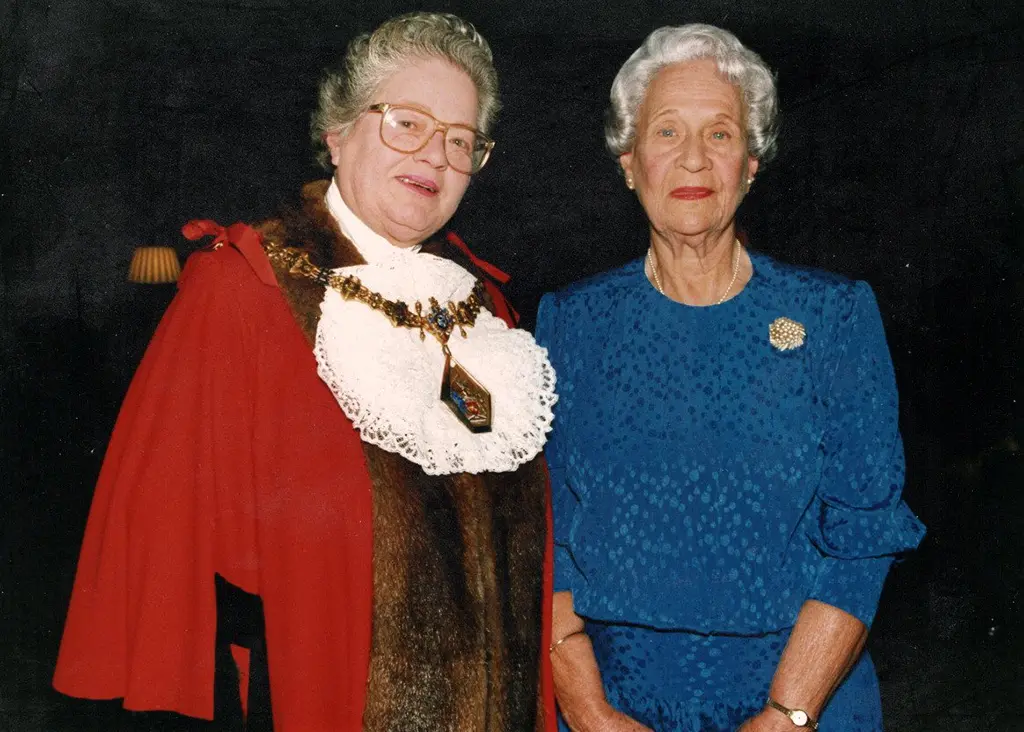
Iris Bayley on the balcony at Andromeda. Source: Bayley family photograph – colorized B&W photograph.
The vitamin C content of the Barbados cherry was researched by Iris Bayley (later: Iris Bannochie) in the late 1940s and 1950s. Her research on the Barbados cherry followed on from the work done by Conrado F Asenjo and Ana Rosa Freire de Guzmán, who in February 1946 published a paper in Science on their discovery that the fruit of the Barbados Cherry contained one of the richest edible sources of Vitamin C (ascorbic acid).
Below is a re-print of one of the publications by Iris Bannochie. This one appeared in The BAJAN in August 1966.
The Barbados cherry is also known as the Acerola cherry. It’s scientific name is: Malpighia glabra.
Barbados Cherries contains 1,500+ mg per 100g of vitamin C whereas 100g of regular lemons and oranges have around 52mg vitamin C. For adults, the recommended daily amount for vitamin C is 65 to 90 milligrams (mg) a day, and the upper limit is 2,000 mg a day.
We had Barbados cherry trees at both Bay Cottage and Andromeda. Granny Bradshaw who lived across the street from what became Andromeda Gardens and who owned it before Mummy and Daddy bought it from her had at least 3 trees that I remember well, because as soon as we got to her house on weekends we went and raided all of them. We also went and climbed the guava trees and picked the small guavas as fast as we could! Not to mention the 100 foot tall almond trees. Our Nanny (Elizabeth Corbin whom we referred to as NIN Nin) was screaming all the while “You children get down outa them trees right now before you all breaks ya necks”. We loved it all!
Even back then we knew about the very high vitamin C content of the Barbados Cherry tree and knew that Mummy was writing about it and gathering all the information that she could. She did experiments about it in the Lab at the Diagnostic Clinic and Hospital.
Patricia Bayley Mull – 3rd of 4 daughters of Dr. Harry Bayley and Iris Bayley. Pati Mull who died on the 19th January 2024.
The Barbados Cherry by Iris Bannochie
The Barbados cherry also known as the Bajan cherry, the West Indian cherry or the Acerola cherry is one of the richest natural sources of Vitamin C in existence.William’s Bajan Cherry tree in blossom.
Many of us in Barbados seem unaware of the importance of a small tree regarded by the islanders as quite commonplace and found growing in many gardens or backyard plots.
This tree known as the Barbados Cherry (Malpighia glabra) is to be found in many parts of the tropics; in Puerto Rico, Hawaii and in Florida where it is cultivated on a large scale and used commercially. We in Barbados, seeking to diversify our agriculture, could find this plant rewarding as we have ideal conditions for its growth.
In 1946 Conrado F Asenjo and Ana Rosa Freire de Guzmán discovered that the fruit of the Barbados Cherry contained one of the richest edible sources of Vitamin C (ascorbic acid), a substance essential for the health of the human body, the lack of which in the days of sailing ships caused scurvy. Later it was found that fresh fruit and vegetables could control this distressing illness which resulted in bleeding, loosening of the teeth, painful joints and wounds which failed to heal.
Cherry tree in blossom. Source: Original image from The BAJAN, August 1966, pages 9 – colorized.
Modern research has proved that ascorbic acid is necessary for many other functions including the manufacture of bone and there is reason to believe that it assists in the prevention of colds. Ascorbic acid is widely distributed, especially in fresh green leaves. Citrus fruit was for a long time considered the best natural source (the Royal Navy still has a daily issue of lime juice as well as rum) but in recent years other fruit including rose hips, black currants, guavas, strawberries, have been found to be rich in Vitamin C. The Barbados Cherry is the richest of them all.
Oranges average 49 milligrams of Vitamin C per 100 grams (about 3½oz. of fruit). Barbados Cherries average over 3,000 milligrams per 100 grams in fruit turning from green to red, and over 2,000 milli grams in the ripe sweet fruit.
The Barbados Cherry is mentioned in Ligon who states: “The fruit is useless and insipid: but the colour something resembling a Cherry, and the shape not much unlike; which caused the planters to call it by that name“. As Ligon’s book was written in 1657 only 30 years after the island was settled, it is evident that the tree was indigenous. Ligon obviously tasted a poor variety.
Cherries on a branch. Source: Original image from The BAJAN, August 1966, pages 9 – colorized.
In the West Indies the plant is usually referred to as the “Cherry”; in Florida, “the Barbados Cherry” the name used in Webster’s Dictionary. In Puerto Rico it is called Acerola, and in other Latin- American countries Cereza (Spanish for Cherry) and it was so called by the early explorers. The name “Barbados Cherry” first appears to have been given to the shrub by Hans Sloane in 1725, when he describes it as growing in gardens in Jamaica.
The plant is known to botanists as Malpighia glabra, a Puerto Rican species as Malpighia punicifolia, however, there is some doubt among botanists as to whether the two names are just describing variations of the same species.
The Barbados Cherry is a much branched, small evergreen tree which grows to a height of from 10 to 15 feet and is found in tropical and subtropical regions, being native to those areas of North and South America. The flowers are numerous, a pretty rosy pink, attracting bees in large numbers. The fruit is almost spherical, turning from light green when immature to yellow and then bright red. There are 3 or 4 separate, triangular seeds and about ⅔ of the fruit is edible. The flavour is not too unusual, something like crab apple or wild raspberry but yet something quite distinct. There is a hint of the romantic tropics, and, it is exceedingly hardy and grows even in the poorest soils. It requires extra lime if grown in acid soils and so flourishes in Barbados. It responds dramatically to good treatment and extra feeding. The trees are relatively free of insect pests and they can withstand drought. The only conditions they do not like are swampy, undrained areas.
Close-up of cherries. Matchstick shows size of the ripe fruit. Source: Original image from The BAJAN, August 1966, pages 11 – colorized.
The size of the crop is determined by the amount of rainfall and fertilizer. Under ideal conditions a Cherry Tree will fruit 8 or 10 times a year. Flowering occurs after heavy rains, with a crop of cherries exactly three weeks after the downpour.
Watering, if sufficient, will also produce the same result and consequently plants grown commercially, can be suitably irrigated. Provided the trees are given some fertilizer, crop after crop occurs in the rainy season, and in wet years some trees will bear almost continuously. Experiments were carried out by the Sub-Tropical Experimental Station of Homestead, Florida and in 1954 they reported an average annual yield, from five-year-old plants, of 21 lbs per tree or 5,880 lbs per acre, nearly three tons, under favourable conditions.
There is a wide variation among the Cherry Trees in the island, the fruit of some being large and sweet, others small and tasteless, the way Ligon described them; in between are the average trees. If we should want to use the Barbados Cherry on a commercial scale, then it would be necessary to use selected clones for planting, that is propagate from our best possible stock. Our present variation is because most of the trees now planted are casual seedlings. The Cherry can also be propagated by cuttings, grafts, and air layers, which will reproduce the same qualities as the parent tree.
The qualities we want to look for in these clones are:-
(a) the plant should produce heavy yields of large fruit with good flavour and a high juice and Vitamin C content.
(b) The fruit should have a relatively thick skin and firm flesh tending to reduce mechanical damage during harvesting.
(c) The growth of the tree should be open and spreading to facilitate picking. This can partly be achieved by correct pruning, but some varieties are definitely bushier than others. On a large-scale harvesting would have to be done by some arrangement of nets.
A survey of the cherry trees would have to be made and the best varieties selected; we may also be able to import better stock from Florida and Puerto Rico.
Apart from growing the trees on a very large scale which could take time, we could make a start by advising everyone with a small plot of land to plant a Cherry Tree or two, to plant some of them on our rab land areas and have several trees around every school in the island, so that the children can eat them freely.
If we consider the cost of an orange and remember that the equivalent Cherry pulp contains almost 80 times more Vitamin C, then it is obvious that we are throwing away, and wasting a most valuable product. Besides Vitamin C, Cherries also contain other vitamins essential for health including: Ribo Flavine, Niacin, Thiamine, B6.
Enterprising hoteliers and restaurateurs could serve a Cherry Punch to visitors. Cherry Daiquiri perhaps?
Uses and Recipes
Apart from the fruit, the Cherry Tree itself makes a handsome hedge and excellent windbreak. The tree is not deciduous and so can also be grown for shade, if properly pruned. During the last war when it was impossible to get fir trees in Barbados a well branch- ed Cherry Tree was used at Christmas. Cut a few weeks before hand, so that the leaves fell off, the branches were then whitewashed and decorated in the usual way. The twigs of the Cherry Tree are sometimes lashed together to make a rough broom for sweeping leaves.
The skin of the Barbados Cherry is easily bruised, and this has been the problem in shipping and handling the fruit. The Vitamin C content is highest just as the fruit is changing colour from green to red and so the fruit can be used from this green stage onwards to full maturity.
Cherry Juice
On a large scale the juice could be extracted by a paddle pulper, similar to that used in making tomato juice. For home consumption I use a mouli food mill or crush the cherries with a fork and squeeze them through a sieve. The juice can be served fresh, sweetened to taste, or it can be frozen and kept for long periods; this is easily done by putting the juice into an ice tray and then storing the cubes in plastic bags in the deep freeze, so that a ready supply is always available.
The Cherry juice can be combined with other fruit like lime, orange, lemon, grapefruit, mango, pineapple, soursop, pawpaw, golden apple, banana, with or without alcohol. It combines well with Gin, Rum, Sherry, and can be substituted in recipes requiring fruit juice.
Cherry Pulp for Desserts
Wash and hull the Cherries, then peel them, keeping as close to the seeds as possible- (it is the peeled portion one eats) the seeds are then rubbed through a sieve and this pulp added to the peeled fruit. We can use these prepared cherries in many ways, storing in the deep freeze, in plastic bags, until needed.
(1) Crush lightly, add sugar to taste and refrigerate for several hours.
(2) Add 2 or 3 tablespoonfuls of water to each pint of fruit, sugar to taste, a little Sherry or Cointreau and put the mixture into a jelly mould, freeze. Turn into a separate dish immediately before serving.
(3) Use the fruit in one of the commercial Gelatine mixtures; Wild Cherry and Raspberry com- bine well; follow the directions on the packet for amount of liquid required and refrigeration directions.
(4) using Gelatine, egg whites etc., you can substitute Cherries for “Prunes” in a “Prune Whip.”
(5) Use in a fruit salad with other fruit.
(6) Cherry Sherbert – 2½cups prepared cherries, add about one cup of sugar (more if the fruit is very acid). Add two tablespoonfuls of orange juice.
Put this into ice tray and allow to freeze until it is mushy and can be stirred with a fork. Add one stiffly beaten egg white to this mixture, freeze, beating once more at the mushy stage.
Vanilla ice-cream, or cream can be served with all the above recipes.
Cooking Cherries
Vitamin C is destroyed by heat and most of the vitamin is lost when fruit or vegetables are cooked. So high is the concentration in our cherries that about one quarter still remains or ten times the equivalent in fresh orange juice!
Cherry Jam
One of the secrets of making good Cherry Jam is to pick fruit the night before, wash and clean the cherries and leave them covered with a cloth in a cool place. Next morning you will find the pulp leaves the seeds more easily. Gently squeeze the fruit and eject the seeds. You can also press them, rub the seeds through a sieve and add to the pulped fruit. Measure your prepared cherries and to each cup add one cup of granulated sugar.
Using a thick bottomed saucepan simmer on low heat, stirring constantly until all the sugar is dissolved, turn up the heat, and allow to boil rapidly, but continue stirring so as not to let the mixture burn. Continue until a thick consistency has been reached and the fruit has become clear. Your spoon lifted out should drop three times as it drains. You will have noticed the two drops stage for some time, but the jam is not finished until it has reached a temperature of 230-236°F / 110-113°C or the three drop stage. Bottle, seal and store the jam in the usual way.
Cherry Jelly
Put washed and hulled cherries into a thick bottomed saucepan and barely cover them with water. Allow to boil and simmer slowly, until the fruit is soft. Gently press the juice out and strain it through muslin or a clean handkerchief. The juice must be strained without excessive squeezing if the jelly is to be clear and sparkling. Measure your juice. To each pint add one pound of sugar (granulated). Dissolve the sugar over low heat by stirring, then boil rapidly without stirring, for about 12-15 minutes. When ready, two drops should come together as one (Temp. 220°F or 104°C). Put the jelly into jars, not quite filling to the top. Do not boil unnecessarily. Quick, short cooking preserves the colour and flavour.
We had been unsuccessful in our search for copies of the Iris Bayley / Iris Bannochie research papers on the Vitamin C content of the Barbados Cherry. Harriet was able to locate The BAJAN article within the Shilstone Memorial Library’s collection.
Please consider making a donation to help support the Shilstone Memorial Library’s ongoing work. Click here to go to the Barbados Museum donation page.
Patricia Bayley Mull
Patricia (Pati) Bayley Mull was the 3rd of the 4 daughters of Dr. Harry Bayley and Iris Bayley. Her father, Dr Harry Bayley died unexpectedly on 14th June 1958. Her mother, Iris re-married in 1964, marrying John Bannochie and together they continued to develop Andromeda Gardens.
In discussion with Pati on her mother’s research on the vitamin C content of the the Barbados cherry, she believed that most of the research her mother undertook was done in the period after Conrado F Asenjo and Ana Rosa Freire de Guzmán published their paper in Science in February 1946 and when her father died in 1958.
Advertisements
Pati died on the 19th January 2024. Pati helped BajanThings on a number of posts:
The Bush Teas of Barbados – Iris Bayley – Pati provided us with the original copy of her mother’s manuscript which we recently re-published as a tribute to her mother.
At the time of Pati’s death we were working with her on locating copies of her mother’s research papers on The vitamin C content of the Barbados cherry which is widely referenced. This is the culmination of that work.
Pati was also very keen to write a piece for BajanThings on Barbados plantocracy during her father’s time… sadly that never came to fruition except as an idea, however, it was something she had very strong opinions on.
We extend our condolences to Pati’s son Robert and to her partner Jim in Florida, as well as her two sisters Peggy who lives in Australia and Harriet who lives in Spain. Rest in Peace Pati Mull.
One response to “The vitamin C content of the Barbados Cherry – Iris Bayley”
Carmen Herrgott
Pati was a dear friend I used to visit every year during my Florida vacations. She always organised a reunion of old Barbados school friends and it became a highlight of the year. I missed her very much during my last visit, especially since we had planned to fly down to Barbados together, but sadly she passed away before I could get to Florida.
I well remember her grandmother Granny Bradshaw’s absolutely delicious cherry jam from the times when I was staying with the Bayley’s at Bay Cottage and Andromeda. It was a delicacy.
Help Us Share More Bajan Stories – Make a Donation:
BajanThings is a passion project dedicated to preserving and sharing Bajan culture, stories, and history.
Your support helps cover the annual costs of running the BajanThings website and fuels our mission to document and share Bajan stories for future generations.
If you would like to be kept informed when there are updates to BajanThings please subscribe to our e-mail update notification. Whenever there is new content added to BajanThings, you will receive an e-mail telling you of the update:
Lord Nelson’s statue – Bridgetown, Barbados has been updated following its removal on 16th November 2020 with details of the public subscribers and details about the forged Nelson-Taylor letter.
Craig Burleigh is an American born, Bajan bred, San Francisco Bay Area based professional photographer. In Barbados Island Life Craig has pulled together his back-catalogue of photographs of Barbados from the 1970s together with the stories behind those photographs. Check out Barbados Island Life.
To get an e-mail update when a new post is added to BajanThings add your e-mail address below and click on the SUBSCRIBE button. Your e-mail address will automatically be added to the BajanThings subscriber list. Whenever there is new content added to BajanThings you will receive an e-mail telling you of the update.