Antarctica is the world’s last remaining wilderness. The name conjures images of the famous explorers like Scott, Shackleton, Amundsen, and more recently Ranulph Fiennes, some of who lost their lives and that of their companions in the quest for exploring the vast unknown cold desert at the South Pole.
Today, any one with a taste for adventure can visit the frozen continent at the tip of the Antarctica Peninsula.
In December 2005 I visited Antarctica on board the USHUAIA, which is a converted NOAA Ice Strengthened research vessel. We departed from Ushuaia for the 2-day crossing of the Drake Passage.
Ushuaia is the southern most city in the world. It is located on the shores of the Beagle Channel, at the southern tip of Argentinian part of Tierra del Fuego Island, right at the bottom of South America.
This trip can be very rough at times. We had a relatively good crossing with large swells coming from the west causing the ship to roll constantly. Once I got accustomed to the motion, and realize that no mater how far she rolled it always returned ready for the next wave I was Ok.
We made our first landing on the mainland at Brown Bluff. During the next 8 days we made landings on the mainland and some of the numerous islands which surround the peninsula. Some were Hanna Point, Whalers Bay, Paradise Bay, and Half Moon Island.
Deception Island is a submerged volcano crater 14.8Km in diameter and is entered through the narrow Neptune’s Bellows. The last eruption was in 1970 when island was abandoned. The British Antarctica Survey Station and a Norwegian whaling station were inspected at Whalers Bay. The remains of the equipment and buildings made this visit very interesting.
We also visited an Argentina Station on King George Island and had our passports stamped.
We made a minimum of 2 landings each day. These were done in inflatable “Zodiac” boats, each carrying 6 to 8 at a time. It took good organization and corporation to get all on shore and back safely again. If the sea was not too rough the Zodiac was able to beach but if not we had to get out and wade a few meters. One day the wind shifted and ice pack filled the bay making it impossible for the boats to collect us. Luckily we were able to walk to another bay that was free of ice.
For each landing the ship first sent a “emergency chest” with blankets, some food and other life support gear, in the event that some or all of us having to spend a few hours waiting for the ice to shift. A doctor was also present at all times.
Antarctica is not a barren land and where the land and sea meet there is an abundance of life. We had to keep 5 meters from the Penguins and 15 meters from seals. For the former, if I sat on a rock and kept quiet the Penguins would approach to within a few meters and look inquisitive at me.
Seals were on every island and for the most part just lay on the snow or on an iceberg. We saw many Whales but the most common was the Humpback. We were treated to a 1-hour visit from a mother and calf as they swam around the boat. It was the only event that delayed dinner for the entire trip.
All types of birds were present: Petrels, Albatross, Cormorant Gulls etc.
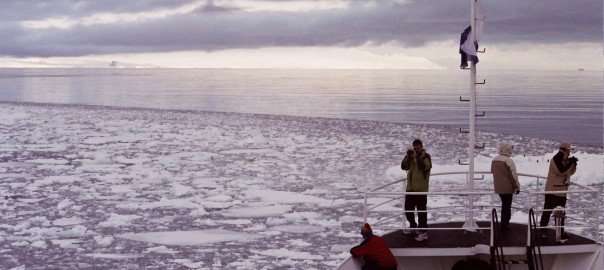
Naturally, ICE is present in all forms – snow, hail, Ice Caps, Glaciers and Icebergs, The colour varies from pure white to many shades of blue, green and even to brown, where the glaciers have carved up the land and taken some of the soils and rock with it. The water varied from “Caribbean Blue” to dark Grey, depending on the depth and rapidly changing weather.
The Ushuaia is a small ship carrying less than 70 passengers. They allowed every one to go ashore at every landing. The convention on protection of wildlife only allows 100 people ashore at one time. With larger cruise ships it is not possible for this to happen. Some of the larger ships do not have landings at all and only sail through. Antarctica is very clean and pristine with no pollution. The Crew on the Ushuaia, and most reputable ships, take great trouble not to introduce any foreign organisms. Before leaving and on return to the ship all boots and shoes are disinfected.
Nothing is left on shore, and we were constantly reminded not to let the smallest bit of paper or plastic get away. I hope it remains this way but with talk of mass tourism going there and setting up ski lodges and such like I fear that this will not last for long.
You can click on the thumbnail image to see a larger image with captions.